Harvard University Press Forlag
-
The Shield. Catalogue of Women. Other Fragments (Bog, Hardback, Engelsk)
Though attributed to Hesiod (eighth or seventh century BC) in antiquity, the Catalogue of Women, a presentation of legendary Greek heroes and episodes... Læs mere
Levering: 6 - 9 hverdage -
Fragmentary Republican Latin, Volume III: Oratory, Part 1 (Bog, Hardback, Engelsk)
Based on the critical edition of Malcovati, this three-volume Loeb edition of Roman Republican oratory begins with Ap. Claudius Caecus (340–273 BC)... Læs mere
Levering: 6 - 9 hverdage -
Ennead VI.1–5 (Bog, Hardback, Engelsk)
Plotinus was the first and greatest of Neoplatonic philosophers. His writings were edited by his disciple Porphyry, who published them sometime between AD 301 and 305 in six sets of... Læs mere
Levering: 6 - 9 hverdage -
Recursive Methods in Economic Dynamics (Bog, Hardback, Engelsk)
This rigorous but brilliantly lucid book presents a self-contained treatment of modern economic dynamics. Stokey, Lucas, and Prescott develop the basic methods of recursive analysis and illustrate the many areas where they can usefully be applied.
Levering: 6 - 9 hverdage -
Lives of Eminent Philosophers, Volume I: Books 1–5 (Bog, Hardback, Engelsk)
Diogenes Laertius compiled his compendium on the lives and doctrines of the ancient philosophers from hundreds of sources. It ranges over three centuries, from Thales to Epicurus, portraying forty-five important figures, and is enriched by numerous quotations.
Levering: 6 - 9 hverdage -
Slave Law and the Politics of Resistance in the Early Atlantic World (Bog, Hardback, Engelsk)
Edward Rugemer’s comparative history, spanning 200 years, reveals the political dynamic between slaves’ resistance and slaveholders’... Læs mere
Levering: Skaffevare (forvent 14 - 30 hverdage) -
Bathers, Bodies, Beauty: The Visceral Eye (Bog, Hardback, Engelsk)
Beginning with the painterly preoccupation with the trope of the bathing nude, Linda Nochlin tracks the subtle permutations of beauty, femininity, and the nude body, from impressionism to postmodernism.
Levering: Skaffevare (forvent 14 - 30 hverdage) -
Evolutionary Dynamics: Exploring the Equations of Life (Bog, Hardback, Engelsk)
Evolution is the one theory that transcends all of biology. Nowak draws on the languages of biology and mathematics to outline the mathematical... Læs mere
Levering: 6 - 9 hverdage -
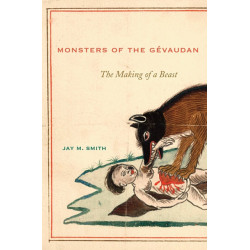
Monsters of the Gevaudan: The Making of a Beast (Bog, Hardback, Engelsk)
In 1764 a peasant girl was killed and partially eaten while tending sheep. Eventually, over a hundred victims fell prey to a mysterious creature whose... Læs mere
Levering: Skaffevare (forvent 14 - 30 hverdage) -
The History of the Kings of Britain: The First Variant Version (Bog, Hardback, Engelsk)
Geoffrey of Monmouth’s History of the Kings of Britain—the earliest book to detail the legendary foundation of Britain and life of King... Læs mere
Levering: 6 - 9 hverdage -
Birds. Lysistrata. Women at the Thesmophoria (Bog, Hardback, Engelsk)
Aristophanes has been admired since antiquity for his wit, fantasy, language, and satire. The protagonists of Birds create a utopian counter-Athens. In... Læs mere
Levering: 6 - 9 hverdage -
History of the Peloponnesian War, Volume II: Books 3–4 (Bog, Hardback, Engelsk)
The Peloponnesian War was really three conflicts (431–421, 415–413, and 413–404 BC) that Thucydides was still unifying into one account when he died... Læs mere
Levering: 6 - 9 hverdage