for at udvide
kategorilisten.
for at udvide
kategorilisten.
Forhistorisk tid

-
Prehistoric and Early Wales (Bog, Paperback / softback, Engelsk)
This volume is based on lectures given when the British Summer School of Archaeology was held at Bangor in August 1959.
Levering: Skaffevare (forvent 14 - 30 hverdage) -
The Iberian Peninsula in the Iron Age through Pottery Studies (Bog, Paperback / softback, Engelsk)
Seven papers read at the international conference, Interdisciplinary research on pottery from the Iberian Peninsula (Poznan, 2019) deal with... Læs mere
Levering: 6 - 9 hverdage -
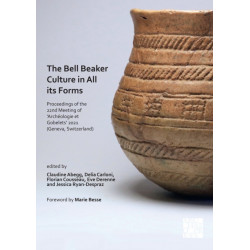
The Bell Beaker Culture in All Its Forms: Proceedings of the 22nd Meeting of ‘Archeologie et Gobelets’ 2021 (Geneva, Switzerland) (Bog, Paperback / softback, Engelsk)
Proceedings of the 22nd meeting of the ‘Archéologie et Gobelets’ Association which took place in Geneva, Switzerland in January 2021. The book is structured in three parts: Archaeological Material, Funerary Archaeology and Anthropology, and Reconstructing Bell Beaker Society.
Levering: 6 - 9 hverdage -
Thirsty Seafarers at Temple B of Kommos: Commercial Districts and the Role of Crete in Phoenician Trading Networks in the Aegean (Bog, Paperback / softback, Engelsk)
The island of Crete was an important place for cultural and economic... Læs mere
Levering: 6 - 9 hverdage -
Prehistoric Flint Mines in Europe (Bog, Paperback / softback, Engelsk)
This volume offers a review of major flint mines dating from the Neolithic to the Bronze Age. The 18 articles were contributed by archaeologists from Belgium, France,... Læs mere
Levering: 6 - 9 hverdage -
The Palaeolithic of Northeast Asia: The History and Results of Research in 1940–1980 (Bog, Paperback / softback, Engelsk)
This volume combines details of discoveries of Palaeolithic sites in a vast region of Northeast Asia (covering mostly the northeastern part of modern Russia), and meticulous analysis of hypotheses, ideas, and concepts related to the Northeast Asian Palaeolithic.
Levering: 6 - 9 hverdage -
Prehistoric Sussex (Bog, Paperback / softback, Engelsk)
A fascinating exploration of prehistoric Sussex from the Palaeolithic era to the Iron Age and the Roman invasion.
Levering: 6 - 9 hverdage -
The Origin and Early Evolution of Life (Bog, Paperback / softback, Engelsk)
Draws on evidence from molecular genetics, the structure and function of extant organisms, and geology. This work emphasises the fact that although life arose very... Læs mere
Levering: Print on Demand (forvent 14 - 30 hverdage) -
The Piltdown Forgery: Fiftieth Anniversary edition, with a new Introduction and Afterword by Chris Stringer (Bog, Paperback / softback, Engelsk)
Chris Stringer of the Natural History Museum in London provides an introduction to the Piltdown... Læs mere
Levering: Skaffevare (forvent 14 - 30 hverdage) -
An Archaeology of Interaction: Network Perspectives on Material Culture and Society (Bog, Paperback / softback, Engelsk)
Drawing particularly on the rich material culture from the Bronze Age of Greece, Knappett foregrounds the network quality of human-artefact interactions, and examines the ways in which societies have succeeded or failed in counterbalancing their costs and benefits.
Levering: Skaffevare (forvent 14 - 30 hverdage) -
Prehistoric America: An Ecological Perspective (Bog, Paperback / softback, Engelsk)
During the past 30 years, the relationship between humans and the environment has changed more drastically than during any previous period in human history
Levering: Skaffevare (forvent 14 - 30 hverdage) -
Iconoclasm and Later Prehistory (Bog, Paperback / softback, Engelsk)
Iconoclasm and Later Prehistory explores approaches from two distinct disciplinary perspectives to present a new interpretative framework for prehistorians and archaeologists alike.
Levering: Skaffevare (forvent 14 - 30 hverdage)