Der er 13 underkategorier
- Afkolonisering af viden / Afkolonialitet
- Flag, emblemer, symboler, logoer
- Fredsstudier og konfliktløsning
- Generelle studier
- Globalisering
- Institutioner og videnskabelige selskaber i almindelighed
- Kognitiv videnskab
- Kommunikationsstudier
- Receptionsstudier eller fortolkningsstudier / publikumsteori
- Regionale studier
- Semiotik / semiologi
- Udviklingsstudier
- Videnskabens historie (samfundsvidenskab og humaniora)
Regionale studier
Visning: Type : Alle | Sprog : Alle | Format : Alle

-
Southeast Asia: The Human Landscape of Modernization and Development (Bog, Hardback, Engelsk)
In this fascinating book, Rigg charts the development of Southeast Asia, examining the former non-market economies of Vietnam, Laos, Cambodia and Burma alongside the more established market economies of the region.
Levering: Skaffevare (forvent 14 - 30 hverdage) -
The Game of Budget Control (Bog, Hardback, Engelsk)
Reproduced here in facsimile, this volume was originally published in 1968 and is available individually. The collection is also available in a number of themed mini-sets of between 5 and 13 volumes, or as a complete collection.
Levering: Skaffevare (forvent 14 - 30 hverdage) -
Economic Geography of Higher Education: Knowledge, Infrastructure and Learning Regions (Bog, Hardback, Engelsk)
This exhaustive study from an experienced and respected set of editors and authors looks at the impact that universities have on their surroundings, with particular reference to regional development.
Levering: Skaffevare (forvent 14 - 30 hverdage) -
Changing Europe: Identities, Nations and Citizens (Bog, Hardback, Engelsk)
This clear and accessible textbook provides an introduction to the key issues now shaping the new Europe and its citizens.
Levering: Skaffevare (forvent 14 - 30 hverdage) -
Rethinking China's Provinces (Bog, Hardback, Engelsk)
This book seeks to locate the province as an administrative level in the Chinese state, through an examination of historic, economic, social and political developments of these units.It contains extensively researched empirical data.
Levering: Skaffevare (forvent 14 - 30 hverdage) -
Political Business in East Asia (Bog, Hardback, Engelsk)
This book is the first comprehensive introduction to government-business relations in the East Asian region, featuring a range of distinguished scholars, with detailed case-studies focussing on Japan, China, South Korea, Malaysia and Thailand.
Levering: Skaffevare (forvent 14 - 30 hverdage) -
Military Politics and Democratization in Indonesia (Bog, Hardback, Engelsk)
This book looks at the role of the Indonesian military in the downfall of Suharto and their ongoing influence on the succeeding governments of B.J. Habibie and Abdurrahman Wahid.
Levering: Skaffevare (forvent 14 - 30 hverdage) -
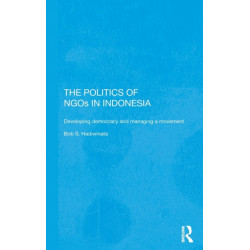
The Politics of NGOs in Indonesia: Developing Democracy and Managing a Movement (Bog, Hardback, Engelsk)
This book deals with two major issues: how Indonesian NGOs survived under Suharto's authoritarian rule; and how NGOs contributed to the promotion of democracy in the post-Suharto era.
Levering: Skaffevare (forvent 14 - 30 hverdage) -
Democracy and National Identity in Thailand (Bog, Hardback, Engelsk)
Explores the process of democratization in Thailand from the overthrow of the monarchist state in the 1930s to the present day and examines this development institutionally and ideologically through key issues.
Levering: Skaffevare (forvent 14 - 30 hverdage) -
Japan's Quiet Transformation: Social Change and Civil Society in 21st Century Japan (Bog, Hardback, Engelsk)
Controversially, this book argues that the Japan that emerges from its manifold problems of the 1990s may be stronger than before.
Levering: Skaffevare (forvent 14 - 30 hverdage) -
Female Sex Trafficking in Asia: The Resilience of Patriarchy in a Changing World (Bog, Hardback, Engelsk)
The book argues that strategies for prevention of female sex trafficking should not be universalized but should be contextualized on the basis of country-specific ground situations.
Levering: Skaffevare (forvent 14 - 30 hverdage) -
Inequality, Crisis and Social Change in Indonesia: The Muted Worlds of Bali (Bog, Hardback, Engelsk)
The aim of this book is to assess the rapidly changing socio-political landscape of Bali in the aftermath of the Asian economic crisis and the collapse of Suharto's 'New Order' regime in Indonesia.
Levering: Skaffevare (forvent 14 - 30 hverdage)