Julia Kristeva Forfatter
Visning: Type : Alle | Sprog : Alle | Format : Alle
-
The The Sense and Non-Sense of Revolt: The Powers and Limits of Psychoanalysis (Bog, Paperback / softback, Engelsk)
Julia Kristeva illustrates the advances and impasses of rebel culture through the experiences of three twentieth-century writers: the existentialist Jean-Paul Sartre, the surrealist Louis Aragon, and the theorist Roland Barthes.
Levering: 6 - 9 hverdage -
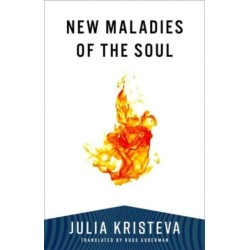
New Maladies of the Soul (Bog, Paperback / softback, Engelsk)
Drawing on her many years of experience as a practicing psychoanalyst, Kristeva reveals to readers a new kind of patient, symptomatic of an age of political upheaval, mass mediated culture, and the dramatic overhaul of familial and sexual mores.
Levering: 6 - 9 hverdage -
The The Severed Head: Capital Visions (Bog, Paperback / softback, Engelsk)
Informed by a provocative exhibition at the Louvre curated by the author, The Severed Head unpacks artistic representations of severed heads from the Paleolithic period to the present.
Levering: 6 - 9 hverdage -
This Incredible Need to Believe (Bog, Paperback / softback, Engelsk)
In this provocative work, Julia Kristeva analyzes the inexorable push toward faith that lies at the heart of the psyche and the history of society.
Levering: 6 - 9 hverdage -
Passions of Our Time (Bog, Paperback / softback, Engelsk)
Passions of Our Time showcases recent essays of Julia Kristeva’s that demonstrate the scope of her capacious intellect, her gifts as a stylist, and the profound contribution of her thought to the challenges of the present.
Levering: 6 - 9 hverdage -
Hatred and Forgiveness (Bog, Paperback / softback, Engelsk)
Julia Kristeva rearticulates and extends her analysis of language, abjection, idealization, female sexuality, love, and forgiveness.
Levering: 6 - 9 hverdage -
-
The The Samurai: A Novel (Bog, Paperback / softback, Engelsk)
A portrait of Parisian intellectuals of the 1960s as seen through the eyes of Olga, a young Eastern European who comes to Paris to write a literary thesis, and finds herself immediately swept into the world of a group of young leftist thinkers and writers known as the Samurai.
Levering: 6 - 9 hverdage -
Proust and the Sense of Time (Bog, Paperback / softback, Engelsk)
Julia Kristeva presents a thoroughly original and compelling reading of Proust’s Remembrance of Things Past, drawing on Proust’s notebooks and manuscripts.
Levering: 6 - 9 hverdage -
Possessions: A Novel (Bog, Paperback / softback, Engelsk)
This sequel to Julia Kristeva’s celebrated allegory The Old Man and the Wolves returns to the corrupt seaside resort of a mythical town, where the boundaries between East and West, civilization and barbarism, and good and evil are erased.
Levering: 6 - 9 hverdage -
The The Old Man and the Wolves: A Novel (Bog, Paperback / softback, Engelsk)
Part detective story, part fable, this novel—narrated by a French journalist—takes the reader to a mythical postindustrial city where the boundaries between East and West, civilization and barbarianism have been erased.
Levering: 6 - 9 hverdage -
Nations Without Nationalism (Bog, Paperback / softback, Engelsk)
Underlying Julia Kristeva’s Nations Without Nationalism is the idea that otherness—whether it be ethnic, religious, social, or political—needs to be understood and accepted in order to guarantee social harmony.
Levering: 6 - 9 hverdage