Central European University Press Forlag
-
The Long Detente: Changing Concepts of Security and Cooperation in Europe, 1950s–1980s (Bog, Hardback, Engelsk)
This book presents evidence that challenges the traditional Cold War narrative, arguing for a fundamentally different understanding of East-West relations during the conflict's later decades.
Levering: Skaffevare (forvent 14 - 30 hverdage) -
Practices of Coexistence: Constructions of the Other in Early Modern Perceptions (Bog, Hardback, Engelsk)
The essays in this book provide interesting contributions to the ongoing debate concerning the representation of differing cultures, i.e., the "image of the Other" in the early modern period.
Levering: Skaffevare (forvent 14 - 30 hverdage) -
Of Red Dragons and Evil Spirits: Post-Communist Historiography between Democratization and the New Politics of History (Bog, Hardback, Engelsk)
The collection of well-researched essays assesses the uses and misuses of history 25 years after the collapse of Soviet hegemony in Eastern Europe.
Levering: Skaffevare (forvent 14 - 30 hverdage) -
A Contested Borderland: Competing Russian and Romanian Visions of Bessarabia in the Second Half of the 19th and Early 20th Century (Bog, Hardback, Engelsk)
Bessarabia, mostly occupied by modern-day republic of Moldova, was the only territory representing an object of rivalry and symbolic competition between the Russian Empire and a fully crystallized nation-state: the Kingdom of Romania.
Levering: Skaffevare (forvent 14 - 30 hverdage) -
Isaac, Iphigeneia, and Ignatius: Martyrdom and Human Sacrifice (Bog, Hardback, Engelsk)
The author considers martyrdom as a voluntary human sacrifice. Pesthy argues that all the peoples in the environment in which Christianity came... Læs mere
Levering: Skaffevare (forvent 14 - 30 hverdage) -
On the Margins: Essays on the History of Jews in Estonia (Bog, Hardback, Engelsk)
Estonia is perhaps the only country in Europe that lacks a comprehensive history of its Jewish minority. Spanning over 150 years of Estonian Jewish history, On the Margins is a truly unique book.
Levering: Skaffevare (forvent 14 - 30 hverdage) -
The Neopopular Bubble: Speculating on "the People" in Late Modern Democracy (Bog, Hardback, Engelsk)
The common critique of media- and ratings-driven politics envisions democracy falling hostage to a popularity contest. By... Læs mere
Levering: Skaffevare (forvent 14 - 30 hverdage) -
Utopian Horizons: Ideology, Politics, Literature (Bog, Hardback, Engelsk)
The 500th anniversary of Thomas More's Utopia has directed attention toward the importance of utopianism. This book investigates the possibilities of cooperation between the humanities and the social sciences in the analysis of 20th century and contemporary utopian phenomena.
Levering: Skaffevare (forvent 14 - 30 hverdage) -
Expanding Intellectual Property: Copyrights and Patents in 20th Century Europe and beyond (Bog, Hardback, Engelsk)
The book deals with the expansion and institutionalization of intellectual property norms in the twentieth century, with a European focus.
Levering: Skaffevare (forvent 14 - 30 hverdage) -
The Invisible Shining: The Cult of Matyas Rakosi in Stalinist Hungary, 19451956 (Bog, Hardback, Engelsk)
This book offers a detailed analysis of the construction, reception, and eventual decline of the cult of the Hungarian Communist Party Secretary, Mátyás Rákosi, one of the most striking examples of orchestrated adulation in the Soviet bloc.
Levering: Skaffevare (forvent 14 - 30 hverdage) -
Great Expectations and Interwar Realities: Cultural Diplomacy in Horthy's Hungary (Bog, Hardback, Engelsk)
Though the study is rooted in Hungary, it explores the dynamic and contingent relationship between identity construction and transnational cultural and political currents in East-Central European nations in the interwar period.
Levering: Skaffevare (forvent 14 - 30 hverdage) -
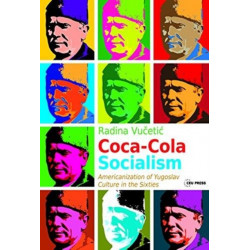
Coca-Cola Socialism: Americanization of Yugoslav Culture in the Sixties (Bog, Hardback, Engelsk)
Examines the Americanization of Yugoslav culture and everyday life during the 1960s, when Tito's regime, after breaking with the Eastern bloc, turned to American cultural models and consumption patterns while maintaining political distance.
Levering: Skaffevare (forvent 14 - 30 hverdage)