Central European University Press Forlag
-
Polish Liberal Thought Before 1918 (Bog, Hardback, Engelsk)
Polish liberalism has generally been considered weak or nonexistent. Janowski, however, argues that 19th century Poland inherited a strong protoliberal tradition and that in mid-19th century, liberalism was dominant in Polish intellectual life.
Levering: Skaffevare (forvent 14 - 30 hverdage) -
Cores, Peripheries, and Globalization (Bog, Hardback, Engelsk)
Examines the intersection of globalization issues with core-periphery dynamics, exploring how the relationships between metropolitan centers and their peripheries shape our understanding of what constitutes globalization and its potential effects.
Levering: Skaffevare (forvent 14 - 30 hverdage) -
Duty to Respond: Mass Crime, Denial, and Collective Responsibility (Bog, Hardback, Engelsk)
Examines responsibility for collective crime, defined as acts committed by significant numbers of group members in the name of the entire group with majority support, targeting individuals based on their group membership.
Levering: Skaffevare (forvent 14 - 30 hverdage) -
A Pragmatic Alliance: Jewish-Lithuanian political cooperation at the beginning of the 20th century (Bog, Hardback, Engelsk)
Examines the political cooperation between Jews and Lithuanians in the Tsarist Empire from the late 19th century to the early 1920s, a period that witnessed significant transformations in both communities' political landscapes.
Levering: Skaffevare (forvent 14 - 30 hverdage) -
Angels, Devils: The Supernatural and Its Visual Representation (Bog, Hardback, Engelsk)
The nine essays in this collection discusses how supernatural phenomena – especially angels and devils – found visual manifestation in Latin and Eastern Christianity as well as Judaism in the late medieval, early renaissance period.
Levering: 6 - 9 hverdage -
Promoting the Saints: Cults and Their Contexts from Late Antiquity until the Early Modern Period (Bog, Hardback, Engelsk)
The studies in this volume concentrate on a complex set of socio-cultural phenomena, the cult of saints, in a variety of regions from Egypt to Poland, with a focus on Italy and Central Europe.
Levering: Skaffevare (forvent 14 - 30 hverdage) -
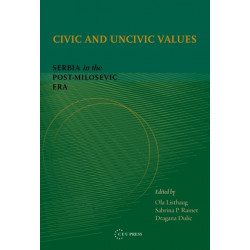
Civic and Uncivic Values: Serbia in the Post-Milosevic Era (Bog, Hardback, Engelsk)
Discusses Serbia’s struggle for democratic values after the fall of the Miloševic regime provoked by the NATO war, and after the trauma caused by the secession of Kosovo.
Levering: Skaffevare (forvent 14 - 30 hverdage) -
Gesta Hungarorum: The Deeds of the Hungarians (Bog, Hardback, Engelsk)
Written between 1282-1285, this is a historical fiction of prehistory, medieval history and contemporary social history. It divides Hungarian history into two... Læs mere
Levering: Skaffevare (forvent 14 - 30 hverdage) -
Anonymus and Master Roger: Anonymus, Notary of King Bela: The Deeds of the Hungarians- Master Roger's Epistle to the Sorrowful Lament Upon the Destruction of the Kingdom of Hungary by the Tatars (Bog, Hardback, Engelsk)
This volume provides unprecedented access to two fundamental texts of medieval Hungarian history, offering both mythical foundation narratives and contemporary disaster documentation, presented with modern scholarly apparatus.
Levering: Skaffevare (forvent 14 - 30 hverdage) -
Debating the Past: Modern Bulgarian Historiography—From Stambolov to Zhivkov (Bog, Hardback, Engelsk)
The book is comprised of the four major debates on modern Bulgarian history from Independence in 1878 to the fall of communism in 1989.
Levering: Skaffevare (forvent 14 - 30 hverdage) -
Ukrainian Witchcraft Trials: Volhynia, Podolia, and Ruthenia, 17th-18th Centuries (Bog, Hardback, Engelsk)
Examines Ukrainian witchcraft trials through quantitative data analysis, first exploring the ideological background based... Læs mere
Levering: Skaffevare (forvent 14 - 30 hverdage) -
Divide, Provide and Rule: An Integrative History of Poverty Policy, Social Reform, and Social Policy in Hungary under the Habsburg Monarchy (Bog, Hardback, Engelsk)
Provides a comprehensive account of how social policy transformed from traditional poor relief to social insurance systems in a European state before World War One, analyzing both older local welfare policies and newer state-operated national social policies
Levering: Skaffevare (forvent 14 - 30 hverdage)