Central European University Press Forlag
Visning: Type : Alle | Sprog : Alle | Format : Alle
-
Governing Divided Societies: Habsburg Austria’s Democratic Legacy and the Czechoslovak First Republic (Bog, Hardback, Engelsk)
The authors of this volume challenge conventional notions about Habsburg and Czechoslovak politics, arguing that they were more democratic than they often appear. They use the consociational model of democracy as a means of combining political science and history.
Levering: Kan forudbestilles (Forventes d. 31-08-2026) -
State-building: A Comparative Study of Ukraine, Lithuania, Belarus, and Russia (Bog, Hardback, Engelsk)
Looks at the process of state-building in Ukraine, Lithuania, Belarus, and Russia from a political economy and institutional perspective.
Status: Skaffevare (forvent 3 - 8 uger) -
Towns between Empires: Good Governance and “Police” in Case Studies from Transylvania, Wallachia, and Moldavia, 1500s-1800s (Bog, Hardback, Engelsk)
This volume analyses urban governance systems in early modern Romanian territories, examining how towns navigated between imperial authorities while developing innovative administrative solutions to political, social, and economic challenges.
Status: Skaffevare (forvent 3 - 8 uger) -
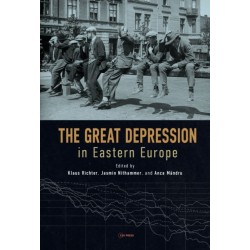
The Great Depression in Eastern Europe (Bog, Hardback, Engelsk)
As the centenary of the Great Depression approaches, this book offers a historical study of its impact on Eastern Europe.
Status: Skaffevare (forvent 3 - 8 uger) -
Working in Music on the Semiperiphery: Local Cultural Production and Global Capitalism (Bog, Hardback, Engelsk)
While music as labor feeds into the capitalist cultural industries, this book proves that in this sector informality greatly permeates and governs power relations and the allocations of resources.
Status: Skaffevare (forvent 3 - 8 uger) -
Literacy and Written Culture in Early Modern Central Europe (Bog, Paperback / softback, Engelsk)
Details Hungary's place on the map of European literacy rates between the Renaissance and Reformation and the developed, state-organized educational systems of the later 19th century. A broad international comparative analysis between literacy rates and written and oral culture.
Status: Skaffevare (forvent 3 - 8 uger) -
Soviet Occupation of Romania, Hungary, and Austria 1944/45–1948/49 (Bog, Paperback / softback, Engelsk)
This book compares the various aspects - political, military economic - of Soviet occupation in Austria, Hungary and Romania. By bringing... Læs mere
Status: Skaffevare (forvent 3 - 8 uger) -
Liberalism After Communism: The Implications of the 1993 Elections to the Federal Assembly (Bog, Hardback, Engelsk)
Examines the emergence and development of liberal political thought in Central Europe, particularly Poland, providing a comprehensive account of protoliberal and liberal thinking before and after 1989,.
Status: Skaffevare (forvent 3 - 8 uger) -
Notions of Nationalism (Bog, Paperback / softback, Engelsk)
Distinguished scholars from both Europe and North America explore various aspects of nationalism and shed light on current theories in this area of crucial importance to an understanding of world politics today.
Levering: Skaffevare (forvent 14 - 30 hverdage) -
Evaluating Science and Scientists (Bog, Hardback, Engelsk)
This book examines how post-communist Eastern Europe's transition to market economies transformed science through funding cuts and peer review systems, providing first-hand accounts and analysis of these reforms' impact on scientific autonomy and resource allocation.
Status: Skaffevare (forvent 3 - 8 uger) -
Freedom for Publishing, Publishing for Freedom (Bog, Paperback / softback, Engelsk)
This is an assessment of the Central and East European Publishing Project, an initiative designed to support embattled Central and East European publishers and journals, and to punch holes through the cultural Iron Curtain by encouraging translations.
Status: Skaffevare (forvent 3 - 8 uger) -
Liberalism in Modern Times (Bog, Hardback, Engelsk)
This study honors the life and work of Brazilian essayist, thinker, and diplomat José G. Merquior, who died prematurely in 1991.
Status: Skaffevare (forvent 3 - 8 uger)