Columbia University Press Forlag
Visning: Type : Alle | Sprog : Alle | Format : Alle
-
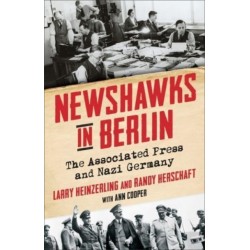
Newshawks in Berlin: The Associated Press and Nazi Germany (Bog, Paperback / softback, Engelsk)
Newshawks in Berlin reveals how the Associated Press covered Nazi Germany from its earliest days through the aftermath of World War II.
Levering: 6 - 9 hverdage -
Surviving the Islamic State: Contention, Cooperation, and Neutrality in Wartime Iraq (Bog, Paperback / softback, Engelsk)
Based on an original survey from Baghdad alongside key interviews in the field, this book offers an insightful account of how Iraqis in different areas of the country responded to the rise and fall of the Islamic State.
Levering: 6 - 9 hverdage -
Wronged: The Weaponization of Victimhood (Bog, Paperback / softback, Engelsk)
In this timely and incisive book, Lilie Chouliaraki shows why claims of victimization are so effective at reinforcing instead of alleviating inequality.
Levering: 6 - 9 hverdage -
Representation: The Birth of Historical Reality from the Death of the Past (Bog, Paperback / softback, Engelsk)
Franklin Rudolf Ankersmit—the preeminent figure in the philosophy of history today—offers a deeply original way of understanding the practice of historical writing and a powerful vindication of history as an empirical discipline.
Levering: 6 - 9 hverdage -
Illusions of Control: Dilemmas in Managing U.S. Proxy Forces in Afghanistan, Iraq, and Syria (Bog, Paperback / softback, Engelsk)
Drawing on extensive field research and hundreds of interviews with stakeholders, Erica L. Gaston unpacks the challenges of attempting to control proxy forces in Afghanistan, Iraq, and Syria.
Levering: 6 - 9 hverdage -
Climate of Contempt: How to Rescue the U.S. Energy Transition from Voter Partisanship (Bog, Paperback / softback, Engelsk)
Climate of Contempt offers a voter-centric, bottom-up explanation of national climate and energy politics, one that pinpoints bitter partisanship as the key impediment to transitioning to a net zero carbon future.
Levering: 6 - 9 hverdage -
Harun Farocki: Forms of Intelligence (Bog, Paperback / softback, Engelsk)
This groundbreaking book is an incisive and comprehensive analysis of Harun Farocki’s oeuvre, shedding new light on his media experimentation and writings across platforms and venues.
Levering: 6 - 9 hverdage -
Mary C. McCall Jr.: The Rise and Fall of Hollywood's Most Powerful Screenwriter (Bog, Paperback / softback, Engelsk)
A screenwriter, novelist, labor leader, Hollywood insider, and feminist, Mary C. McCall Jr. was one of the film industry’s most powerful figures in the 1940s and early 1950s. J. E. Smyth tells McCall’s remarkable story for the first time.
Levering: 6 - 9 hverdage -
Beyond Power Transitions: The Lessons of East Asian History and the Future of U.S.-China Relations (Bog, Paperback / softback, Engelsk)
Examining the rise and fall of East Asian powers over 1,500 years, Beyond Power Transitions offers a new perspective on the forces that shape war and peace.
Levering: 6 - 9 hverdage -
The The Politics of Sorrow: Unity and Allegiance Across Tibetan Exile (Bog, Paperback / softback, Engelsk)
The Politics of Sorrow tells the story of the Group of Thirteen, a collective of chieftains and lamas from the regions of Kham and Amdo, who sought to preserve Tibet’s cultural diversity in exile.
Levering: 6 - 9 hverdage -
Discovered but Forgotten: The Maldives in Chinese History, c. 1100-1620 (Bog, Paperback / softback, Engelsk)
Discovered but Forgotten is a pioneering examination of China’s relations with the Maldives and Sino-Indian Ocean interactions, offering new ways to understand Chinese maritime exploration and the global history of the Indian Ocean.
Levering: 6 - 9 hverdage -
The The Japanese Ideology: A Marxist Critique of Liberalism and Fascism (Bog, Paperback / softback, Engelsk)
Tosaka Jun—a major Marxist thinker and critic in 1930s Japan—offers a ruthless philosophical critique of contemporary ideology that exposes liberalism’s deep complicity with fascism.
Levering: 6 - 9 hverdage