Columbia University Press Forlag
Visning: Type : Alle | Sprog : Alle | Format : Alle
-
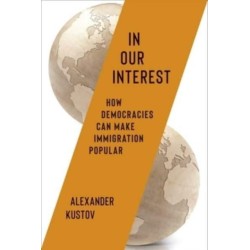
In Our Interest: How Democracies Can Make Immigration Popular (Bog, Paperback / softback, Engelsk)
In this data-driven, counterintuitive book, Alexander Kustov argues that showing people how immigration benefits them and their fellow citizens can lead to greater acceptance of more open policies.
Levering: 6 - 9 hverdage -
Viacheslav Ivanov: A Symbolist Life (Bog, Hardback, Engelsk)
A poet, scholar, philosopher, religious thinker, translator, and teacher, Viacheslav Ivanov (1866–1949) was one of the most extraordinary figures of Russia’s... Læs mere
Levering: 6 - 9 hverdage -
The The Care of the Self and the Care of the Other: From Spiritual Exercises to Political Transformation (Bog, Paperback / softback, Engelsk)
This book explores the ways several twentieth-century thinkers—Pierre Hadot, Georges Friedmann, Michel Foucault, Martin Luther King Jr., and Audre Lorde—can help us relate the ethical transformation of the self and the political transformation of the world.
Levering: 6 - 9 hverdage -
The The Passion of Pedro Almodovar: A Self-Portrait in Seven Films (Bog, Hardback, Engelsk)
James Miller considers seven of Pedro Almodóvar’s most personal films, arguing that together they offer a revealing self-portrait of the director and his search for meaning.
Levering: 6 - 9 hverdage -
Democracy and Beauty: The Political Aesthetics of W. E. B. Du Bois (Bog, Hardback, Engelsk)
Robert Gooding-Williams reconstructs W. E. B. Du Bois’s defense of the political potential of beauty to challenge oppressive systems and foster an inclusive democracy.
Levering: Skaffevare (forvent 14 - 30 hverdage) -
Downtime: The Twentieth Century in Slow Motion (Bog, Paperback / softback, Engelsk)
Downtime explores the history and aesthetics of slow motion, from its origins in early film to its prominence today.
Levering: 6 - 9 hverdage -
Attention and Alienation: The International Political Economy of Information and Communication Technologies (Bog, Paperback / softback, Engelsk)
Aarushi Bhandari offers a new way to understand the political economy of attention, combining quantitative analysis and personal narrative to critique the role of information and communications technologies in global society.
Levering: 6 - 9 hverdage -
People's Choice Literature: The Most Wanted and Unwanted Novels (Bog, Paperback / softback, Engelsk)
People’s Choice Literature presents two novels based on a nationwide poll about literary taste—one featuring the story elements Americans most desire and another containing everything Americans despise.
Levering: 6 - 9 hverdage -
The The Documentary Audit: Listening and the Limits of Accountability (Bog, Paperback / softback, Engelsk)
Pooja Rangan develops a framework for understanding how documentary practices have, under the mantle of accountability, provided a moral cover for listening habits that are used to profile, exclude, and incarcerate.
Levering: 6 - 9 hverdage -
Misguided: Where Misinformation Starts, How It Spreads, and What to Do About It (Bog, Paperback / softback, Engelsk)
Why are people inclined to believe misinformation? This wide-ranging and comprehensive book shines a light on how false beliefs take root and spread, exploring the cognitive, emotional, and social factors that make us susceptible.
Levering: 6 - 9 hverdage -
New Story of the Stone: An Early Chinese Science Fiction Novel (Bog, Paperback / softback, Engelsk)
One of China’s first works of science fiction, New Story of the Stone is a belated twentieth-century sequel to the beloved eighteenth-century masterpiece Story of the Stone (more famously known as Dream of the Red Chamber).
Levering: 6 - 9 hverdage -
Binswanger and Existential Analysis (Bog, Paperback / softback, Engelsk)
This book presents Michel Foucault’s unpublished manuscript on the Swiss psychiatrist Ludwig Binswanger for the first time in English, offering crucial insight into his intellectual development.
Levering: 6 - 9 hverdage