Edinburgh University Press Forlag
Visning: Type : Alle | Sprog : Engelsk | Format : Paperback / softback Der vises kun varer på engelsk
-
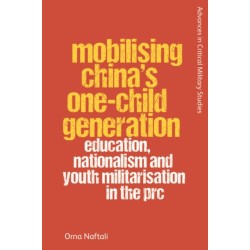
Mobilising China's One-Child Generation: Education, Nationalism and Youth Militarisation in the PRC (Bog, Paperback / softback, Engelsk)
Explores the militarisation of education and youth in contemporary China.
Levering: 6 - 9 hverdage -
Crime, Space and Place: New Geographical Perspectives (Bog, Paperback / softback, Engelsk)
A critical introduction to the geographies of crime. The authors examine crime through the lenses of space and place including topics such as... Læs mere
Levering: 6 - 9 hverdage -
Working For Each Other: A Philosophical Account of the Need for Work (Bog, Paperback / softback, Engelsk)
Deryn Thomas challenges the anti-work narrative by showing work not to be an individual need, but a collective one, a social activity... Læs mere
Levering: 6 - 9 hverdage -
A Capitalism's Handmaidens: Myth and Women’s Enterprise Under Neoliberalism (Bog, Paperback / softback, Engelsk)
A powerful mythology has grown up around the idea of women’s entrepreneurship. Langworthy offers a political economy of women’s enterprise and asks what... Læs mere
Levering: 6 - 9 hverdage -
The Third Duke of Buccleuch and Adam Smith: Estate Management and Improvement in Enlightenment Scotland (Bog, Paperback / softback, Engelsk)
This book examines the career of Henry Scott, third Duke of Buccleuch (1746-1812), with particular focus on his relationship with his tutor and friend, the philosopher Adam Smith, and the management of his extensive Scottish estates.
Levering: 6 - 9 hverdage -
The Sutherland Estate, 1850-1920: Aristocratic Decline, Estate Management and Land Reform (Bog, Paperback / softback, Engelsk)
This volume is a study of the Sutherland Estate, one of the most famous landed estates in the Highlands and Britain as a whole, principally for its leading role in the Highland Clearances of the early nineteenth century.
Levering: 6 - 9 hverdage -
The Scottish Soldier and Empire, 1854-1902 (Bog, Paperback / softback, Engelsk)
The Scottish Soldier and Empire, 1854-1902 reflects upon the iconic role of the Scottish soldier as an empire builder from the Crimean War to the end of the nineteenth century.
Levering: 6 - 9 hverdage -
Scottish Women: A Documentary History, 1780-1914 (Bog, Paperback / softback, Engelsk)
Drawing on a wide range of source materials from across Scotland, this sourcebook provides new insights into women’s attitudes to the society in which they lived, and how they negotiated their identities within private and public life.
Levering: 6 - 9 hverdage -
Scottish Presbyterians and the Act of Union 1707 (Bog, Paperback / softback, Engelsk)
Focusing predominantly on the period between April 1706 and January 1707, the book examines the attitudes and reactions of Presbyterians to the treaty and challenges many of the widely held assumptions about the role of the church and other groups during the debate.
Levering: 6 - 9 hverdage -
Scotland and the French Revolutionary War, 1792-1802 (Bog, Paperback / softback, Engelsk)
Scotland and the French Revolutionary War, 1792-1802 aims to provide an up-dated discussion of the nature and extent of Scottish support for the British state in the 1790s.
Levering: 6 - 9 hverdage -
Remembering the Past in Nineteenth-Century Scotland: Commemoration, Nationality and Memory (Bog, Paperback / softback, Engelsk)
At a time when the Union between Scotland and England is once again under the spotlight, Remembering the Past in Nineteenth-Century Scotland examines the way in which Scotland’s national heroes were once remembered as champions of both Scottish and British patriotism.
Levering: 6 - 9 hverdage -
Religion and National Identity: Governing Scottish Presbyterianism in the Eighteenth Century (Bog, Paperback / softback, Engelsk)
This book offers a fresh perspective on the Presbyterian legacy in contemporary Scottish historiography, at the same time as informing current debates on national identity.
Levering: 6 - 9 hverdage