Pelagic Publishing Forlag
-
Rhythms of Nature: Wildlife and Wild Places Between the Moors (Bog, Paperback / softback, Engelsk)
After a career in conservation, Ian Carter moves to a secluded farmhouse tucked away in the low hills of mid-Devon between Exmoor and... Læs mere
Levering: 6 - 9 hverdage -
Ancient Woods, Trees and Forests: Ecology, History and Management (Bog, Paperback / softback, Engelsk)
Today, ‘virgin forests’ are only to be found at a few sites unreachable by humans, and even then they are affected by climate change,... Læs mere
Levering: Skaffevare (forvent 14 - 30 hverdage) -
Treated Like Animals: Improving the Lives of the Creatures We Own, Eat and Use (Bog, Paperback / softback, Engelsk)
Society’s arbitrary and inconsistent grouping of animals according to their ‘use’ means that we tolerate institutionalised... Læs mere
Levering: 6 - 9 hverdage -
Field Guide to the Birds of North America (Bog, Paperback / softback, Engelsk)
A complete, yet compact and user-friendly, field guide to all the birds of the USA and Canada. Drawing on years of guiding experience, the book is designed to be the easiest guide to use in the field while birding. Covering 1,100 species with over 6,000 illustrations.
Levering: 6 - 9 hverdage -
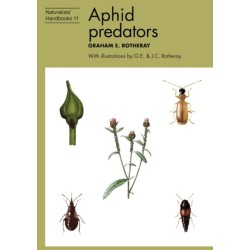
Aphid predators (Bog, Hardback, Engelsk)
Aphids and their colonies are excellent arenas in which to observe predators in action. A range of insects come to eat or parasitise the aphids or to drink their honeydew.
Levering: Skaffevare (forvent 14 - 30 hverdage) -
Animals of the surface film (Bog, Hardback, Engelsk)
This handbook deals with the smaller invertebrate animals of this surface community. Among these are springtails, pondskaters, water boatmen, water beetles and water spiders, as well as protozoa, rotifers and tiny crustaceans.
Levering: Skaffevare (forvent 14 - 30 hverdage) -
Field Guide to the Snakes of Eswatini (Bog, Paperback / softback, Engelsk)
This field guide is the first book to describe all 63 of the recorded snake species found in Eswatini. All are beautifully presented with detailed descriptions, accurate distribution maps and over 350 photographs. Includes advice on snake-bite.
Levering: 6 - 9 hverdage -
The Merlin: The Ecology of a Magical Raptor (Bog, Paperback / softback, Engelsk)
This book explains the complex origins and behaviours of the Merlin, from its obscure fossil ancestors through to the contemporary challenges that it faces... Læs mere
Levering: 6 - 9 hverdage -
No Island Too Far: Searching for Seabirds on Remote Specks of Land (Bog, Paperback / softback, Engelsk)
No Island Too Far takes the reader across all the world’s oceans to a matchless array of islands, often crowded with wildlife, sometimes... Læs mere
Levering: Kan forudbestilles (Forventes d. 19-01-2027) -
The Effective Ecologist: Succeed in the Office Environment (Bog, Paperback / softback, Engelsk)
The Effective Ecologist covers the stuff that no-one told you about at university - how to develop your business and office-related skills to... Læs mere
Levering: Skaffevare (forvent 14 - 30 hverdage) -
Seaweeds of the British Isles: Chlorophyta (Bog, Paperback / softback, Engelsk)
This volume covers the species attributed to the class Chlorophyta (the green seaweeds). Each species description incorporates notes on ecology and distribution and many are supported by line illustrations.
Levering: Skaffevare (forvent 14 - 30 hverdage) -
Bee Conservation: Evidence for the effects of interventions (Bog, Paperback / softback, Engelsk)
This book brings together scientific evidence and experience relevant to the practical conservation of wild bees. The authors worked with an international group of bee experts and conservationists to develop a global list of interventions that could benefit wild bees.
Levering: Skaffevare (forvent 14 - 30 hverdage)