Palæontologi
Visning: Type : Alle | Sprog : Alle | Format : Alle

-
Bemærk: Kan ikke leveres før jul.
Evolutionary Stasis and Change in the Dominican Republic Neogene (Bog, Paperback / softback, Engelsk)Science is supposedly ultimately constrained by the nature of the physical world, meaning that changes in scientific methods and practice... Læs mere
Levering: Skaffevare (forvent 14 - 30 hverdage) -
Bemærk: Kan ikke leveres før jul.
The Postcranial Anatomy of Australopithecus afarensis: New Insights from KSD-VP-1/1 (Bog, Paperback / softback, Engelsk)This volume describes a 3.6 million-years-old partial skeleton of Australopithecus afarensis from the Woranso-Mille, central Afar, Ethiopia.
Levering: Skaffevare (forvent 14 - 30 hverdage) -
Bemærk: Kan ikke leveres før jul.
Africa from MIS 6-2: Population Dynamics and Paleoenvironments (Bog, Paperback / softback, Engelsk)Bringing together archaeological, paleoenvironmental, paleontological and genetic data, this book makes a first attempt to reconstruct African population histories from out species' evolution to the Holocene.
Levering: Skaffevare (forvent 14 - 30 hverdage) -
Bemærk: Kan ikke leveres før jul.
Multidisciplinary Approaches to the Study of Stone Age Weaponry (Bog, Paperback / softback, Engelsk)Levering: Skaffevare (forvent 14 - 30 hverdage) -
Bemærk: Kan ikke leveres før jul.
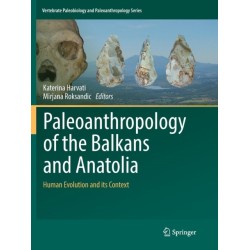
Paleoanthropology of the Balkans and Anatolia: Human Evolution and its Context (Bog, Paperback / softback, Engelsk)This edited volume systematically reviews the evidence for early human presence in one of the most relevant geographic... Læs mere
Levering: Skaffevare (forvent 14 - 30 hverdage) -
Bemærk: Kan ikke leveres før jul.
Ichnoentomology: Insect Traces in Soils and Paleosols (Bog, Hardback, Engelsk)This book is devoted to the ichnology of insects, and associated trace fossils, in soils and paleosols. Readers will discover how insect trace... Læs mere
Levering: Skaffevare (forvent 14 - 30 hverdage) -
Bemærk: Kan ikke leveres før jul.
Dynamic Paleontology: Using Quantification and Other Tools to Decipher the History of Life (Bog, Paperback / softback, Engelsk)Using a series of case studies, the book demonstrates the power of dynamic analysis as applied to the fossil record.
Levering: Skaffevare (forvent 14 - 30 hverdage) -
Bemærk: Kan ikke leveres før jul.
Azokh Cave and the Transcaucasian Corridor (Bog, Paperback / softback, Engelsk)The site is also important due to the discovery of Neanderthal remains by the current research group in addition to the Middle Pleistocene hominin fossils during a previous phase of excavation work led by M.
Levering: Skaffevare (forvent 14 - 30 hverdage) -
Bemærk: Kan ikke leveres før jul.
Ichnoentomology: Insect Traces in Soils and Paleosols (Bog, Paperback / softback, Engelsk)This book is devoted to the ichnology of insects, and associated trace fossils, in soils and paleosols. Readers will discover how insect trace... Læs mere
Levering: Skaffevare (forvent 14 - 30 hverdage) -
Bemærk: Kan ikke leveres før jul.
Human Paleontology and Prehistory: Contributions in Honor of Yoel Rak (Bog, Paperback / softback, Engelsk)Levering: Skaffevare (forvent 14 - 30 hverdage) -
Bemærk: Kan ikke leveres før jul.
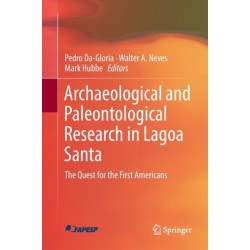
Archaeological and Paleontological Research in Lagoa Santa: The Quest for the First Americans (Bog, Paperback / softback, Engelsk)This groundbreaking volume presents, for the first time in English, a broad historical review of the researches carried out over 170 years in the region of Lagoa Santa, Brazil, one of the most important archaeological regions in the Americas.
Levering: Skaffevare (forvent 14 - 30 hverdage) -
Bemærk: Kan ikke leveres før jul.
Palaeobiology of Middle Paleozoic Marine Brachiopods: A Case Study of Extinct Organisms in Classical Paleontology (Bog, Paperback / softback, Engelsk)Fossil species appear to persist morphologically unchanged for long intervals of geologic time, punctuated by short bursts of rapid change as explained by the Ecological Evolutionary Units (EEUs).
Levering: Skaffevare (forvent 14 - 30 hverdage)