Andreas Ochsner Forfatter
Visning: Type : Alle | Sprog : Alle | Format : Alle
-
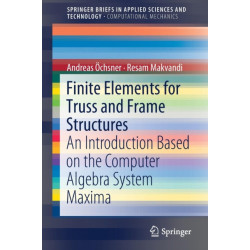
Finite Elements for Truss and Frame Structures: An Introduction Based on the Computer Algebra System Maxima (Bog, Paperback / softback, Engelsk)
This book is intended as an essential study aid for the finite element method.
Levering: Skaffevare (forvent 14 - 30 hverdage) -
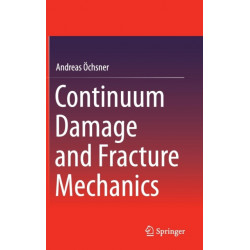
Continuum Damage and Fracture Mechanics (Bog, Hardback, Engelsk)
This textbook offers readers an introduction to fracture mechanics, equipping them to grasp the basic ideas of the presented approaches to modeling in applied... Læs mere
Levering: Skaffevare (forvent 14 - 30 hverdage) -
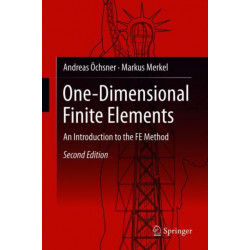
One-Dimensional Finite Elements: An Introduction to the FE Method (Bog, Hardback, Engelsk)
This textbook presents finite element methods using exclusively one-dimensional elements.
Levering: 6 - 9 hverdage -
Computational Statics and Dynamics: An Introduction Based on the Finite Element Method (Bog, Paperback / softback, Engelsk)
In order to deepen readers’ understanding of the equations and theories discussed, each chapter also includes supplementary problems. These problems start with fundamental knowledge questions on the theory presented in the respective chapter, followed by calculation problems.
Levering: Skaffevare (forvent 14 - 30 hverdage) -
Numerical Engineering Optimization: Application of the Computer Algebra System Maxima (Bog, Paperback / softback, Engelsk)Levering: Skaffevare (forvent 14 - 30 hverdage)
-
Partial Differential Equations of Classical Structural Members: A Consistent Approach (Bog, Paperback / softback, Engelsk)
The derivation and understanding of Partial Differential Equations relies heavily on the fundamental knowledge of the first years of scientific education, i.e., higher mathematics, physics, materials science, applied mechanics, design, and programming skills.
Levering: Skaffevare (forvent 14 - 30 hverdage) -
Finite Elements Using Maxima: Theory and Routines for Rods and Beams (Bog, Paperback / softback, Engelsk)
for equation solving, highlights the methodology of the finite element method rather than standard procedures. The book is based on the Springer Brief “Finite Elements for Truss and Frame Structures” (978-3-319-94940-6) by the same authors.
Levering: Skaffevare (forvent 14 - 30 hverdage) -
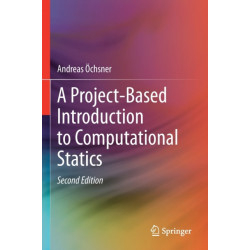
A Project-Based Introduction to Computational Statics (Bog, Paperback / softback, Engelsk)
This book uses a novel concept to teach the finite element method, applying it to solid mechanics.
Levering: Skaffevare (forvent 14 - 30 hverdage) -
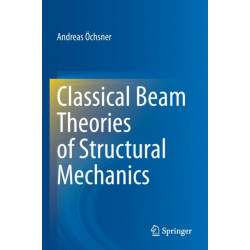
Classical Beam Theories of Structural Mechanics (Bog, Paperback / softback, Engelsk)
This book provides a systematic and thorough overview of the classical bending members based on the theory for thin beams (shear-rigid) according to Euler-Bernoulli, and the theories for thick beams (shear-flexible) according to Timoshenko and Levinson.
Levering: Skaffevare (forvent 14 - 30 hverdage) -
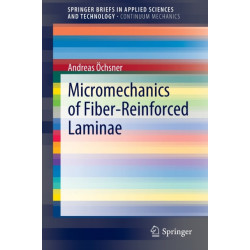
Micromechanics of Fiber-Reinforced Laminae (Bog, Paperback / softback, Engelsk)Levering: Skaffevare (forvent 14 - 30 hverdage)
-
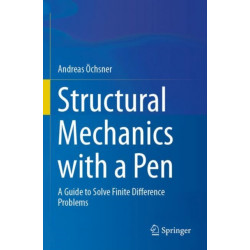
Structural Mechanics with a Pen: A Guide to Solve Finite Difference Problems (Bog, Paperback / softback, Engelsk)
This book is focused on the introduction of the finite difference method based on the classical one-dimensional structural members, i.e., rods/bars and beams.
Levering: Skaffevare (forvent 14 - 30 hverdage) -
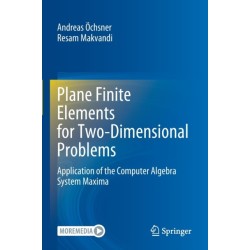
Plane Finite Elements for Two-Dimensional Problems: Application of the Computer Algebra System Maxima (Bog, Paperback / softback, Engelsk)
The mechanical theories focus on the classical two-dimensional structural elements, i.e., plane elements, thin or classical plates, and thick or shear deformable plate elements.
Levering: Skaffevare (forvent 14 - 30 hverdage)