Georges Cuvier Forfatter
-
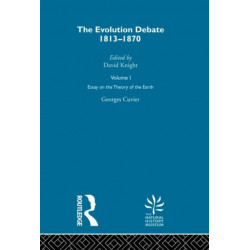
Essay on the Theory of the Earth, 1813 (Bog, Hardback, Engelsk)
Based at the Parisian Museum of Natural History, Cuvier was able to compare the fossil bones he dug from the quarries of Montmartre with those of animals alive today.
Levering: Skaffevare (forvent 14 - 30 hverdage) -
German Colonialism and National Identity (Bog, Paperback / softback, Engelsk)
This original study applies post-colonial questions and methods to the study of Germany and its culture, combining political and cultural approaches, the study of literature and art, and the examination of both metropolitan and local discourses and memories.
Levering: Skaffevare (forvent 14 - 30 hverdage) -
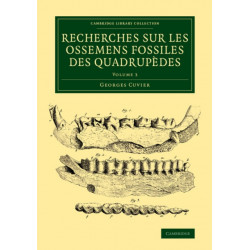
Recherches sur les ossemens fossiles des quadrupedes (Bog, Paperback / softback, Engelsk)
In the 1790s Georges Cuvier (1769–1832), one of the founding figures of vertebrate palaeontology, proved that extinction was a scientific fact. This... Læs mere
Levering: Print on Demand (forvent 14 - 30 hverdage) -
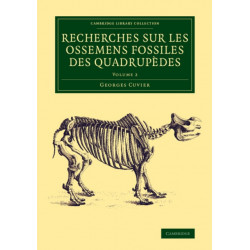
Recherches sur les ossemens fossiles des quadrupedes (Bog, Paperback / softback, Engelsk)
In the 1790s Georges Cuvier (1769–1832), one of the founding figures of vertebrate palaeontology, proved that extinction was a scientific fact. This... Læs mere
Levering: Print on Demand (forvent 14 - 30 hverdage) -
Recherches sur les ossemens fossiles des quadrupedes (Bog, Paperback / softback, Engelsk)
In the 1790s Georges Cuvier (1769–1832), one of the founding figures of vertebrate palaeontology, proved that extinction was a scientific fact. This... Læs mere
Levering: Print on Demand (forvent 14 - 30 hverdage) -
Recherches sur les ossemens fossiles des quadrupedes (Bog, Paperback / softback, Engelsk)
In the 1790s Georges Cuvier (1769–1832), one of the founding figures of vertebrate palaeontology, proved that extinction was a scientific fact. This... Læs mere
Levering: Print on Demand (forvent 14 - 30 hverdage) -
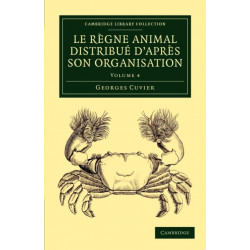
Le regne animal distribue d'apres son organisation: Pour servir de base a l'histoire naturelle des animaux et d'introduction a l'anatomie comparee (Bog, Paperback / softback, Engelsk)
Eminent French scientist Georges Cuvier (1769–1832) spent his life... Læs mere
Levering: Print on Demand (forvent 14 - 30 hverdage) -
Le regne animal distribue d'apres son organisation: Pour servir de base a l'histoire naturelle des animaux et d'introduction a l'anatomie comparee (Bog, Paperback / softback, Engelsk)
Eminent French scientist Georges Cuvier (1769–1832) spent his life... Læs mere
Levering: Print on Demand (forvent 14 - 30 hverdage) -
Le regne animal distribue d'apres son organisation: Pour servir de base a l'histoire naturelle des animaux et d'introduction a l'anatomie comparee (Bog, Paperback / softback, Fransk)
Eminent French scientist Georges Cuvier (1769–1832) spent his life... Læs mere
Levering: Print on Demand (forvent 14 - 30 hverdage) -
Le regne animal distribue d'apres son organisation: Pour servir de base a l'histoire naturelle des animaux et d'introduction a l'anatomie comparee (Bog, Paperback / softback, Fransk)
Eminent French scientist Georges Cuvier (1769–1832) spent his life... Læs mere
Levering: Print on Demand (forvent 14 - 30 hverdage) -
A Classified Index and Synopsis of the Animal Kingdom: Arranged in Conformity with its Organization (Bog, Paperback / softback, Engelsk)
The most influential work of French biologist and comparative anatomist Georges Cuvier (1769–1832), Le Règne Animal, was published in French in 1817, and this sixteen-volume illustrated English version appeared between 1827 and 1835.
Levering: Print on Demand (forvent 14 - 30 hverdage) -
The Animal Kingdom: Arranged in Conformity with its Organization (Bog, Paperback / softback, Engelsk)
The most influential work of French biologist and comparative anatomist Georges Cuvier (1769–1832), Le Règne Animal, was published in French in 1817, and this sixteen-volume illustrated English version appeared between 1827 and 1835.
Levering: Print on Demand (forvent 14 - 30 hverdage)