Martin Buber Forfatter
-
Between Man and Man (Bog, Paperback / softback, Engelsk)
Martin Buber believed that life's deepest truth lies in human relationships. In this classic work he puts this belief into practice, applying it to the concrete problems of contemporary society.
Levering: 6 - 9 hverdage -
Paths in Utopia (Bog, Paperback / softback, Engelsk)
In this work, Buber expounds upon and defends the Zionist experiment - a federal system of communities on a co-operative basis. He looks to the anarchists Proudhon, Kropotkin and Gustav Landauer, but selects only that part of their doctrines appropriate to his case.
Levering: Skaffevare (forvent 14 - 30 hverdage) -
The Way of Man: According to the Teachings of Hasidism (Bog, Paperback / softback, Engelsk)
This remarkable work presents the essential teachings of Hasidism, the mystical Jewish movement which swept Eastern Europe in the eighteenth and nineteenth centuries. It is a truly life-enhancing book.
Levering: 6 - 9 hverdage -
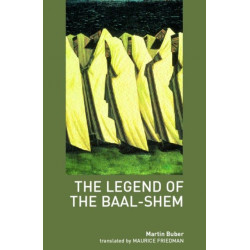
The Legend of the Baal-Shem (Bog, Paperback / softback, Engelsk)
These twenty stories about the founder of the Hasidic faith, provide a charming account of the genesis of Hasidism. This is an ideal introduction to Hasidic religion, and to Buber's influential philosophy of love and human understanding.
Levering: Skaffevare (forvent 14 - 30 hverdage) -
Ten Rungs: Collected Hasidic Sayings (Bog, Paperback / softback, Engelsk)
The sacred tales collected here by Buber have their origins in Hasidic tradition. Through Biblical riddles and Jewish proverbs they seek teach the reader an awareness of the need for self-recognition and spiritual renewal.
Levering: Skaffevare (forvent 14 - 30 hverdage) -
Meetings: Autobiographical Fragments (Bog, Paperback / softback, Engelsk)
This reveals the life of Martin Buber, in his own words. A series of reflections and narratives, it does not aim to describe his life in full, but rather conveys some of his defining moments of uncertainty, contact, revelation and meaning.
Levering: Skaffevare (forvent 14 - 30 hverdage) -
Between Man and Man (Bog, Hardback, Engelsk)
Martin Buber believed that life's deepest truth lies in human relationships. In this classic work he puts this belief into practice, applying it to the concrete problems of contemporary society.
Levering: Skaffevare (forvent 14 - 30 hverdage) -
A Land of Two Peoples: Martin Buber on Jews and Arabs (Bog, Paperback / softback, Engelsk)Levering: 6 - 9 hverdage
-
Ecstatic Confessions: The Heart of Mysticism (Bog, Paperback / softback, Engelsk)
Beginning with Buber's seminal essay on mysticism, this book offers texts down the centuries from oriental, pagan, Gnostic, Eastern Orthodox, Catholic, Jewish... Læs mere
Levering: Skaffevare (forvent 14 - 30 hverdage) -
On Zion: The History of an Idea (Bog, Paperback / softback, Engelsk)
This volume grew out of a series of lectures by the author in 1944. He analyzes the centrality of Zion to biblical and Talmudic thought, how it inspired medieval thinkers and mystics, and how it moved modern Jews from Moses Hess to Ray Kook and A.D. Gordon.
Levering: Skaffevare (forvent 14 - 30 hverdage) -
Two Types of Faith: A Study of the Interpenetration of Judaism and Christianity (Bog, Paperback / softback, Engelsk)
Martin Buber contrasts the ""faith of Abraham"" with the ""faith of St Paul"" and ponders the possibilities of reconciliation between the two. He offers a sincere and reverent Jewish view of Christ and of the unique and decisive character of His message to Jew and Gentile.
Levering: Skaffevare (forvent 14 - 30 hverdage)