Archaeopress Forlag
Visning: Type : Alle | Sprog : Alle | Format : Alle
-
Territoires et ressources des societes neolithiques du Bassin parisien: le cas du Neolithique moyen (4500 – 3800 av. n. e.) (Bog, Paperback / softback, Fransk)
The aim of this book is to study forms of territorial patterning and resource management in the middle Neolithic I and II, between 4500 and 3800 BC in the Paris basin.
Levering: 6 - 9 hverdage -
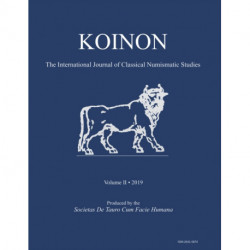
KOINON II, 2019: The International Journal of Classical Numismatic Studies (Bog, Paperback / softback, Engelsk)
KOINON includes papers concerning iconography, die studies, provenance research, forgery analysis, translations of excerpts from antiquarian works, specialized bibliographies, corpora of rare varieties and types, ethical questions on laws and collecting, book reviews, and more.
Levering: 6 - 9 hverdage -
The Classification of Chalcolithic and Early Bronze Age Copper and Bronze Axe-heads from Southern Britain (Bog, Paperback / softback, Engelsk)
This work presents a comprehensive classification of the morphology of early metal age axe-heads, chisels and stakes from southern Britain. It is illustrated by a type series of 120 representative examples.
Levering: 6 - 9 hverdage -
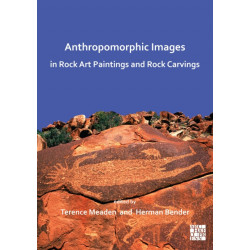
Anthropomorphic Images in Rock Art Paintings and Rock Carvings (Bog, Paperback / softback, Engelsk)
In rock art, humanlike images appear widely throughout the ages. The artworks discussed in this book range from paintings, engravings or... Læs mere
Levering: 6 - 9 hverdage -
Late Iron Age and Roman Settlement at Bozeat Quarry, Northamptonshire: Excavations 1995-2016 (Bog, Paperback / softback, Engelsk)
MOLA (formerly Northamptonshire Archaeology), has undertaken intermittent archaeological work within Bozeat... Læs mere
Levering: 6 - 9 hverdage -
Reindeer hunters at Howburn Farm, South Lanarkshire: A Late Hamburgian settlement in southern Scotland – its lithic artefacts and natural environment (Bog, Hardback, Engelsk)
This volume presents the lithic assemblage from Howburn in South... Læs mere
Levering: 6 - 9 hverdage -
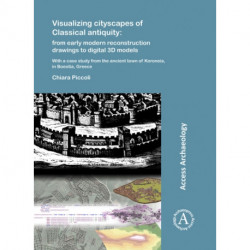
Visualizing cityscapes of Classical antiquity: from early modern reconstruction drawings to digital 3D models: With a case study from the ancient town of Koroneia in Boeotia, Greece (Bog, Paperback / softback, Engelsk)
The study presented here aims to make a practical contribution to a new understanding and use of digital 3D reconstructions in archaeology, namely as ‘laboratories’ to test hypotheses and visualize, evaluate and discuss multiple interpretations.
Levering: 6 - 9 hverdage -
The History and Archaeology of Cathedral Square Peterborough (Bog, Paperback / softback, Engelsk)
Reports on archaeological work undertaken ahead of an improvement scheme centred on Cathedral Square, the historic centre of Peterborough, by Northamptonshire Archaeology, now MOLA Northampton, commissioned by Opportunity Peterborough (Peterborough City Council).
Levering: 6 - 9 hverdage -
Pottery Production, Landscape and Economy of Roman Dalmatia: Interdisciplinary approaches (Bog, Paperback / softback, Engelsk)
This book presents interdisciplinary research carried out on the Roman sites of pottery workshops active within the coastal area of the province of Dalmatia as well as on material recovered during the excavations.
Levering: 6 - 9 hverdage -
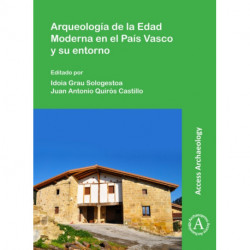
Arqueologia de la Edad Moderna en el Pais Vasco y su entorno (Bog, Paperback / softback, Spansk)
This book aims to provide a summary of the current archaeological framework for investigations of the Modern Age in the Basque Country, and to make proposals for developing these practices in the future.
Levering: 6 - 9 hverdage -
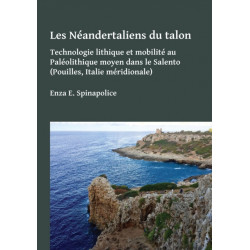
Les Neandertaliens du talon: Technologie lithique et mobilite au Paleolithique moyen dans le Salento (Pouilles, Italie meridionale) (Bog, Paperback / softback, Fransk)
Focussing on the abundant Middle Palaeolithic sites in the Salento region... Læs mere
Levering: 6 - 9 hverdage -
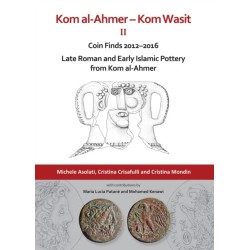
Kom al-Ahmer – Kom Wasit II: Coin Finds 2012–2016 / Late Roman and Early Islamic Pottery from Kom al-Ahmer (Bog, Hardback, Engelsk)
This volume presents over 1070 coins (ca. 310 BC–AD 641) and 1320 examples of Late Roman and Early Islamic pottery. Kom al-Ahmer and Kom Wasit emerge as centers of an exchange network involving large-scale trade of raw materials to and from the central and eastern Mediterranean.
Levering: 6 - 9 hverdage