Cotswold Archaeology Forlag
-
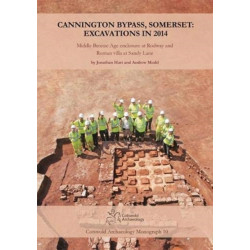
Cannington Bypass, Somerset: Excavations in 2014: Middle Bronze Age Enclosure at Rodway and Roman Villa at Sandy Lane (Bog, Hardback, Engelsk)
Two enclosures were recorded – near Rodway was discovered a small Middle Bronze Age farmstead containing evidence of two roundhouses, with associated pottery and plant remains; and at Sandy Lane a Roman villa was shown to have developed from a Late Iron Age ridge-top settlement.
Levering: 6 - 9 hverdage -
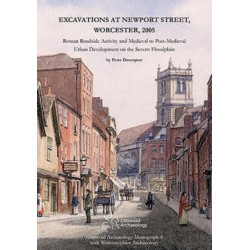
Excavations at Newport Street, Worcester, 2005: Roman Roadside Activity and Medieval to Post-Medieval Urban Development on the Severn Floodplain (Bog, Hardback, Engelsk)
Excavation of approximately a third of a hectare in the north-western part of the historic core of Worcester revealed evidence for activity dating from the Roman to the post-medieval and early modern period.
Levering: 6 - 9 hverdage -
Medieval and Post-Medieval Occupation and Industry in the Redcliffe Suburb of Bristol: Excavations at 1-2 and 3 Redcliff Street, 2003-2010 (Bog, Hardback, Engelsk)
Excavations at 1–2 and 3 Redcliff Street, Bristol, revealed domestic and industrial remains dating from the establishment of the Redcliffe suburb in the 12th century through to the later post-medieval period.
Levering: 6 - 9 hverdage -
The Prehistoric Archaeology of the A477 St Clears to Red Roses Road Improvement Scheme 2012 (Bog, Hardback, Engelsk)
A Mesolithic site in the lower Tâf valley. Early Neolithic pits and a post-built structure at Cildywyll. Near St Clears the remains of an Early Bronze Age barrow, 38 burials (some urned) and pyre site, also a Middle Bronze Age drying oven. A Bronze Age burnt mound near Red Roses.
Levering: 6 - 9 hverdage -
Living Near the Edge: Archaeological Investigations in the Western Cotswolds along the route of the Wormington to Sapperton Gas Pipeline, 2006-2010 (Bog, Hardback, Engelsk)
An Iron Age settlement on Salter’s Hill, Winchcombe, included an Early Iron Age roundhouse, while Middle Iron Age grain-storage pits here and elsewhere indicated other farming settlements.
Levering: 6 - 9 hverdage -
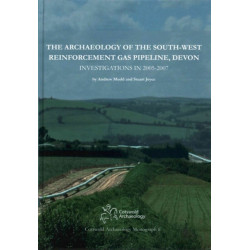
The Archaeology of the South-West Reinforcement Gas Pipeline, Devon (Bog, Hardback, Engelsk)
Archaeological work ahead of pipeline construction in East and South Devon led to the excavation of over thirty sites spanning the earlier Neolithic to early modern times. Early features included a wide scatter of pits dating to the Neolithic and Beaker periods (c.
Levering: 6 - 9 hverdage -
Living and working in a medieval and later Bristol suburb: Excavations at Redcliff Quarter 2016–2018 (Bog, Hardback, Engelsk)
Excavations undertaken ahead of redevelopment at Redcliff Quarter, Bristol, enabled the investigation of medieval and later properties along Redcliff Street and St Thomas Street.
Levering: 6 - 9 hverdage -
The Wreck of the London: Archaeological Investigations of a 17th-century Warship (Bog, Hardback, Engelsk)
Archaeological investigations at the site of the London wreck reveal the remains of a 17th-century English second-rate... Læs mere
Levering: 6 - 9 hverdage