Harvard University Press Forlag
-
Dialogues: Actius (Bog, Hardback, Engelsk)
Dialogues, Volume 2 by Giovanni Gioviano Pontano contains both a perceptive treatment of poetic rhythm, the first full treatment of the Latin hexameter in the history of... Læs mere
Levering: 6 - 9 hverdage -
Apocalypse. An Alexandrian World Chronicle (Bog, Hardback, Engelsk)
The Apocalypse informed medieval expectations of the end of the world, responses to strange and exotic invaders, and the legend of Alexander the Great. An... Læs mere
Levering: 6 - 9 hverdage -
Old English Lives of Saints (Bog, Hardback, Engelsk)
Old English Lives of Saints, a series composed in the 990s by the Benedictine monk Aelfric, portrays an array of saints—including virgin martyrs, kings, soldiers,... Læs mere
Levering: 6 - 9 hverdage -
Expulsions: Brutality and Complexity in the Global Economy (Bog, Hardback, Engelsk)
Income inequality, displaced and imprisoned populations, destruction of land and water: today’s dislocations cannot be understood in the usual... Læs mere
Levering: 6 - 9 hverdage -
Fragments, Volume I: Aegeus–Meleager (Bog, Hardback, Engelsk)
Euripides (ca. 485–406 BC) has been prized in every age for his emotional and intellectual drama. Eighteen of his ninety or so plays survive complete, including Medea,... Læs mere
Levering: 6 - 9 hverdage -
Alexandrian War. African War. Spanish War (Bog, Hardback, Engelsk)
Aulus Hirtius, friend of and military subordinate to Caesar (100–44 BC), may have written the Alexandrian War. African War and Spanish War are detailed accounts... Læs mere
Levering: 6 - 9 hverdage -
Civil War (Bog, Hardback, Engelsk)
Civil War provides a vigorous, direct, clear, third-personal, impassioned account of Caesar’s campaigns during the civil war of 49–48 BC, drawn from his three books of commentarii.
Levering: 6 - 9 hverdage -
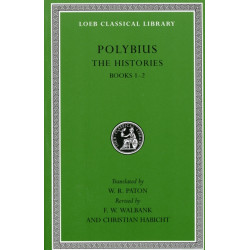
The Histories, Volume I: Books 1–2 (Bog, Hardback, Engelsk)
In his history, Polybius (ca. 200–118 BC) is centrally concerned with how and why Roman power spread. The main part of the work, a vital achievement despite the... Læs mere
Levering: 6 - 9 hverdage -
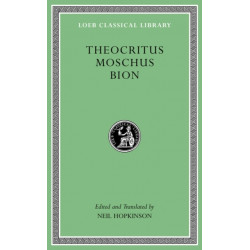
Theocritus. Moschus. Bion (Bog, Hardback, Engelsk)
Theocritus (early third century BC) was the inventor of the bucolic genre, also known as pastoral. The present edition of his work, along with that of his successors Moschus (fl.... Læs mere
Levering: 6 - 9 hverdage -
The Apostolic Fathers, Volume I: I Clement. II Clement. Ignatius. Polycarp. Didache (Bog, Hardback, Engelsk)
The writings of the Apostolic Fathers (first and second centuries AD) give a rich and diverse picture of Christian life and thought in the period immediately after New Testament times. Some were accorded almost Scriptural authority in the early Church.
Levering: 6 - 9 hverdage -
Odyssey, Volume I: Books 1–12 (Bog, Hardback, Engelsk)
The Iliad and the Odyssey of Homer (eighth century BC) are the two oldest European epic poems. The latter tells of Odysseus’ journey home from the Trojan War and the temptations, delays, and dangers he faced at every turn.
Levering: 6 - 9 hverdage -
Anabasis (Bog, Hardback, Engelsk)
The Anabasis by Xenophon (ca. 430–ca. 354 BC) is an eyewitness account of Greek mercenaries’ challenging “March Up-Country” from Babylon back to the coast of Asia Minor under Xenophon’s guidance in 401 BC.
Levering: 6 - 9 hverdage