Pallas Publications Forlag
Visning: Type : Alle | Sprog : Alle | Format : Alle
-
Regionalism after Regionalisation: Spain, France and the United Kingdom (Bog, Paperback / softback, Engelsk)
Concentrating on three countries, Spain, France and the United Kingdom, and three regional case studies of Galicia, Brittany and Wales, this book offers an analysis of the development of political regionalism after regionalisation.
Levering: Skaffevare (forvent 14 - 30 hverdage) -
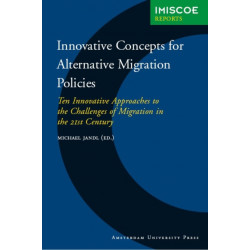
Innovative Concepts for Alternative Migration Policies: Ten Innovative Approaches to the Challenges of Migration in the 21st Century (Bog, Paperback / softback, Engelsk)
This book presents ten new proposals for innovative migration policies and is intended to stimulate fresh thinking among researchers and policy makers alike.
Status: Skaffevare (forvent 3 - 8 uger) -
Handbook of Japanese Christian Writers (Bog, Hardback, Engelsk)
Although a century and a half of Christian proselytizing has only led to the conversion of about one percent of the Japanese population, the proportion of writers who have either been baptized or significantly influenced in their work by Christian teachings is much higher.
Levering: Skaffevare (forvent 14 - 30 hverdage) -
Practising Citizenship and Heterogeneous Nationhood: Naturalisations in Swiss Municipalities (Bog, Paperback / softback, Engelsk)
Analyses in a comparative perspective naturalisation processes in Swiss municipalities and explores new theoretical and analytical approaches to the study of citizenship.
Status: Skaffevare (forvent 3 - 8 uger) -
The Cinema of Attractions Reloaded (Bog, Paperback / softback, Engelsk)
What have Lumière in common with Wachowski? About the attractiveness and usefulness of the term “cinema of attractions” for both pre-classical and post-classical cinema.
Levering: Skaffevare (forvent 14 - 30 hverdage) -
Employment 'Miracles': A Critical Comparison of the Dutch, Scandinavian, Swiss, Australian and Irish Cases versus Germany and the US (Bog, Paperback / softback, Engelsk)
A critical scrutiny of the ‘miracle economies’ of the 1990s, analysing the role of the relatively small size of the national economies in question, and of accidental external circumstances which contributed to favourable developments.
Levering: Skaffevare (forvent 14 - 30 hverdage) -
Handbook of Sport and Japan (Bog, Hardback, Engelsk)
The Handbook of Sport and Japan presents a fascinating collection of established and new scholarship, a valuable text for readers who want to use sport as lens to look more... Læs mere
Status: Skaffevare (forvent 3 - 8 uger) -
Communication Research into the Digital Society: Fundamental Insights from the Amsterdam School of Communication Research (Bog, Paperback / softback, Engelsk)
This book provides a broad overview of the ways in which people create, use, and... Læs mere
Status: Skaffevare (forvent 3 - 8 uger) -
Public Diplomacy in Ireland and Japan (Bog, Hardback, Engelsk)
This book traces the evolution of this growing branch of diplomacy and examines the role it has played in the foreign policies of Ireland and Japan, and in their... Læs mere
Status: Skaffevare (forvent 3 - 8 uger) -
Trauma and Nostalgia: Practices in Memory and Identity (Bog, Hardback, Engelsk)
The volume enhances our understanding of how the entanglements of trauma and nostalgia influence the construction and development of identity.
Status: Skaffevare (forvent 3 - 8 uger) -
Contingent Loyalties: State Agents in the Yunnan Borderlands (1856-1911) (Bog, Hardback, Engelsk)
The book presents an original framework that examines, compares, and contrasts local actors from a bigger, connected, and dynamic... Læs mere
Levering: Skaffevare (forvent 14 - 30 hverdage) -
Renaissance Masculinities, Diplomacy, and Cultural Transfer: Federico and Ferrante Gonzaga in Italy and Beyond (Bog, Hardback, Engelsk)
This book uses epistolary, literary, and material sources to argue that the boyhood and adult experiences of Federico and Ferrante Gonzaga are illustrative of wider strategies adopted by elite Italians to respond to conflict and crisis in a global age.
Levering: Skaffevare (forvent 14 - 30 hverdage)