Stanford University Press Forlag
-
The Children of Solaga: Indigenous Belonging Across the U.S.-Mexico Border (Bog, Paperback / softback, Engelsk)
Drawing on ethnographic fieldwork between Los Angeles, California and San Andrés Solaga, a Zapotec town in the Mexican state of... Læs mere
Levering: 6 - 9 hverdage -
Unmentionables: Textiles, Garment Work, and the Syrian American Working Class (Bog, Paperback / softback, Engelsk)
As weavers, garment workers, and peddlers, Syrian immigrants in the Americas fed the early twentieth-century transnational... Læs mere
Levering: 6 - 9 hverdage -
Foreign Aid and State Building in Interwar Romania: In Quest of an Ideal (Bog, Hardback, Engelsk)
The decades following World War I were a period of transformation for Central and Eastern Europe. This book considers the role of... Læs mere
Levering: Skaffevare (forvent 14 - 30 hverdage) -
Ideology and Meaning-Making Under the Putin Regime (Bog, Paperback / softback, Engelsk)
This book provides an innovative, multi-method analysis of the Russian regime's ideological production process and the ways it is operationalized in... Læs mere
Levering: 6 - 9 hverdage -
The Borders of Privilege: 1.5-Generation Brazilian Migrants Navigating Power Without Papers (Bog, Paperback / softback, Engelsk)
Brazilians to show how their ability to be perceived as white—their power without papers—shaped their everyday... Læs mere
Levering: 6 - 9 hverdage -
Billie's Bent Elbow: Exorbitance, Intimacy, and a Nonsensuous Standard (Bog, Paperback / softback, Engelsk)
Deeply informed by jazz, Billie's Bent Elbow explores the nonsensical in black radical thought and expression. Extending the encounter... Læs mere
Levering: 6 - 9 hverdage -
Unpublished Fragments (Summer 1886–Fall 1887): Volume 17 (Bog, Paperback / softback, Engelsk)
This volume of the Complete Works provides the first English translation of Friedrich Nietzsche's unpublished notes from 1886 to 1887 and documents the evolution of Nietzsche's thinking on such important themes as nihilism, eternal recurrence, and the revaluation of all values.
Levering: 6 - 9 hverdage -
Rachel Carson and the Power of Queer Love (Bog, Hardback, Engelsk)
In this moving new book, political theorist Lida Maxwell offers close readings that suggest Rachel Carson's relationship with Dorothy Freeman was central to her writing of Silent Spring—a work whose defense of vibrant nonhuman nature allowed love to flourish.
Levering: 6 - 9 hverdage -
Is It Racist? Is It Sexist?: Why Red and Blue White People Disagree, and How to Decide in the Gray Areas (Bog, Hardback, Engelsk)
Is It Racist? Is It Sexist? In this book, Jessi Streib and Betsy Leondar-Wright offer a new way of understanding these questions and how inequalities persist by focusing on the individual judgment calls that lead us to decide what's racist, what's sexist, and what's not.
Levering: 6 - 9 hverdage -
Eros and Empire: The Transnational Struggle for Sexual Freedom in the United States (Bog, Hardback, Engelsk)
The history of queer politics in the United States since 1968 is commonly narrated as either a progressive campaign or... Læs mere
Levering: 6 - 9 hverdage -
Common Circuits: Hacking Alternative Technological Futures (Bog, Paperback / softback, Engelsk)
Based on long-term field research across San Francisco, Tokyo, and Shenzhen, Common Circuits explores a transnational network of hacker spaces that stand as potent, but often invisible, alternatives to the dominant technology industry.
Levering: 6 - 9 hverdage -
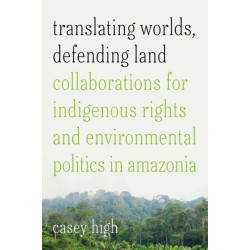
Translating Worlds, Defending Land: Collaborations for Indigenous Rights and Environmental Politics in Amazonia (Bog, Paperback / softback, Engelsk)
Based on fieldwork over a period of twenty-five years, Casey High explores how Waorani people took to the streets of Amazonian Ecuador to protest drilling on their ancestral lands, and what these engagements mean for Indigenous communities.
Levering: 6 - 9 hverdage