Andreas Ochsner Forfatter
-
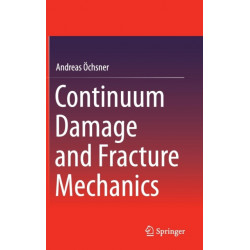
Continuum Damage and Fracture Mechanics (Bog, Hardback, Engelsk)
This textbook offers readers an introduction to fracture mechanics, equipping them to grasp the basic ideas of the presented approaches to modeling in applied... Læs mere
Levering: Skaffevare (forvent 14 - 30 hverdage) -
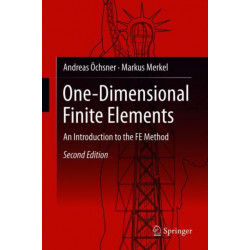
One-Dimensional Finite Elements: An Introduction to the FE Method (Bog, Hardback, Engelsk)
This textbook presents finite element methods using exclusively one-dimensional elements.
Levering: 6 - 9 hverdage -
Mechanics of Classical Sandwich Structures (Bog, Hardback, Engelsk)
This book treats the mechanical behavior of one-dimensional sandwich structures, a typicaloncept in the context of lightweight design. In addition, an... Læs mere
Levering: Skaffevare (forvent 14 - 30 hverdage) -
Elements of Classical Plasticity Theory (Bog, Hardback, Engelsk)
Considering three-dimensional plasticity, different sets of stress invariants to characterize the stress matrix and the decomposition of the stress matrix in its... Læs mere
Levering: Skaffevare (forvent 14 - 30 hverdage) -
A Numerical Approach to the Simplified Laminate Theory of Composite Materials: The Composite Laminate Analysis Tool—CLAT 1D (Bog, Hardback, Engelsk)
Understandingthis simplified theory is much easier and the final step it to... Læs mere
Levering: Skaffevare (forvent 14 - 30 hverdage) -
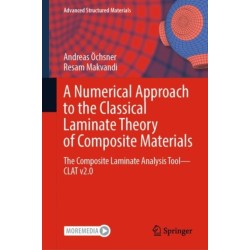
A Numerical Approach to the Classical Laminate Theory of Composite Materials: The Composite Laminate Analysis Tool—CLAT v2.0 (Bog, Hardback, Engelsk)
This book first provides a systematic and thorough introduction to the classical laminate theory for composite materials based on the theory for plane elasticity elements and classical (shear-rigid) plate elements.
Levering: Skaffevare (forvent 14 - 30 hverdage) -
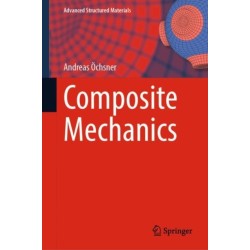
Composite Mechanics (Bog, Hardback, Engelsk)
This book in the advanced structured materials series provides first an introduction to the mircomechanics of fiber-reinforced laminae, which deals with the prediction of the... Læs mere
Levering: Skaffevare (forvent 14 - 30 hverdage) -
Plane Finite Elements for Two-Dimensional Problems: Application of the Computer Algebra System Maxima (Bog, Hardback, Engelsk)
The mechanical theories focus on the classical two-dimensional structural elements, i.e., plane elements, thin or classical plates, and thick or shear deformable plate elements.
Levering: Skaffevare (forvent 14 - 30 hverdage) -
A Numerical Approach to the Micromechanics of Fibre-Reinforced Laminae: The Micromechanics Analysis Tool—MMAT v1.0 (Bog, Hardback, Engelsk)
This book treats the micromechanics of laminae, i.e., the prediction of the macroscopic mechanical lamina properties based on the mechanical properties of the constituents, i.e., fibers and matrix.
Levering: Skaffevare (forvent 14 - 30 hverdage) -
Foundations of Classical Laminate Theory (Bog, Hardback, Engelsk)
This book provides a systematic and thorough introduction to the classical laminate theory based on the theory for plane elasticity elements and classical... Læs mere
Levering: Skaffevare (forvent 14 - 30 hverdage) -
Classical Beam Theories of Structural Mechanics (Bog, Hardback, Engelsk)
This book provides a systematic and thorough overview of the classical bending members based on the theory for thin beams (shear-rigid) according to Euler-Bernoulli, and the theories for thick beams (shear-flexible) according to Timoshenko and Levinson.
Levering: Skaffevare (forvent 14 - 30 hverdage) -
Structural Mechanics with a Pen: A Guide to Solve Finite Difference Problems (Bog, Hardback, Engelsk)
This book is focused on the introduction of the finite difference method based on the classical one-dimensional structural members, i.e., rods/bars and beams.
Levering: Skaffevare (forvent 14 - 30 hverdage)