Central European University Press Forlag
-
Survival under Dictatorships: Life and Death in Nazi and Communist Regimes (Bog, Hardback, Engelsk)
A complex array of individual responses to the abuse of power by the state is represented in this book in three horrific episodes in the history of East-Central Europe.
Levering: Skaffevare (forvent 14 - 30 hverdage) -
Beyond the Siege of Leningrad: One Woman’s Life during and after the Occupation: The Recollections of Evdokiia Vasil’evna Baskakova-Bogacheva (Bog, Hardback, Engelsk)
This memoir about the experiences of German occupation during the siege of Leningrad (now Saint Petersburg) was written by Moscow-born Evdokiia Vasil’evna Baskakova-Bogacheva (1888–1976), an émigré in Australia, at the age of eighty-one.
Levering: 6 - 9 hverdage -
The The Art of Witnessing: Documentary Art, Literature, Film and Theatre in Eastern Europe and the Baltics (Bog, Hardback, Engelsk)
This volume discusses documentary film, theatre, and literature from the 1960s to the 2020s in... Læs mere
Levering: Kan forudbestilles (Forventes d. 31-07-2026) -
Captured Societies in Southeast Europe: Networks of Trust and Control (Bog, Hardback, Engelsk)
The series aims to catalyze and showcase social research that is fundamentally grounded in engagement and interaction at the ground level in Southeast Europe, prioritizing grassroots perspectives and lived experiences.
Levering: Skaffevare (forvent 14 - 30 hverdage) -
Steamboat Modernity: Travel, Transport, and Social Transformation on the Lower Danube, 1830-1860 (Bog, Hardback, Engelsk)
Through a skillful combination of economic and cultural history, this book describes the impact on Moldavia and Wallachia of steam navigation on the Danube. The Danube route integrated the two principalities into a dense network of European roads and waterways.
Levering: Skaffevare (forvent 14 - 30 hverdage) -
Remembering Suffering and Resistance: Memory Politics and the Serbian Orthodox Church (Bog, Hardback, Engelsk)
Assessing issues related to the Orthodox Church from an academic, secular point of view is a sensitive matter.
Levering: Skaffevare (forvent 14 - 30 hverdage) -
Biopower in Putin’s Russia: From Taking Care to Taking Lives (Bog, Hardback, Engelsk)
In this book, Makarychev and Medvedev examine the importance of biopolitics in fueling Russia’s confrontation with the West. In their view, the development of Putin’s illiberal authoritarianism was largely triggered by what they call a biopolitical turn.
Levering: Skaffevare (forvent 14 - 30 hverdage) -
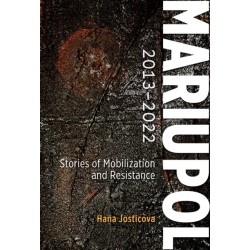
Mariupol 2013-2022: Stories of Mobilization and Resistance (Bog, Hardback, Engelsk)
The book focuses on Mariupol, formerly Ukraine's tenth largest city, and the second largest in the Donbas region, examining this coastal town during a critical period of Ukrainian history.
Levering: Skaffevare (forvent 14 - 30 hverdage) -
Riverine Citizenship: A Bosnian City in Love with the River (Bog, Hardback, Engelsk)
This book examines how environmental threats can transform personal attachments to natural spaces into powerful political movements, using the Una River dam controversy to explore the emergence of riverine citizenship.
Levering: Skaffevare (forvent 14 - 30 hverdage) -
The Habsburg Garrison Complex in Trebinje: A Lost World (Bog, Hardback, Engelsk)
By using a micro-historical approach, this innovative book tells the story of the garrison in times of peace and war, describing the way in which the Austro-Hungarian administration rapidly transformed Trebinje into a tree-lined city dominated by the army.
Levering: Skaffevare (forvent 14 - 30 hverdage) -
Canada and Eastern Europe, 1945–1991: Meeting in the Middle (Bog, Hardback, Engelsk)
The work examines Canada's relations with member-states of the Warsaw Pact during the Cold War.
Levering: 6 - 9 hverdage -
Czechoslovakia at the World’s Fairs: Behind the Facade (Bog, Hardback, Engelsk)
This book provides a comprehensive account of Czechoslovak participation in international exhibitions during the crucial interwar period (1918-1939), offering deep insights into how the newly formed nation presented itself on the global stage.
Levering: Skaffevare (forvent 14 - 30 hverdage)