Harvard University Press Forlag
-
War in the Wild East: The German Army and Soviet Partisans (Bog, Hardback, Engelsk)
Shepherd enters the debate over the wartime behavior of the Wehrmacht with a detailed study of the motivation and conduct of its anti-partisan... Læs mere
Levering: Skaffevare (forvent 14 - 30 hverdage) -
Dionysiaca, Volume III: Books 36–48 (Bog, Hardback, Engelsk)
This epic poem concerns Dionysus’ earthly career from birth at Thebes to reception on Olympus. In a poem full of mythology, astrology, and magic, Nonnos relates the god’s conquest of the East and also, sensually and explicitly, his amorous adventures.
Levering: 6 - 9 hverdage -
Autobiography and Selected Letters, Volume I: Autobiography. Letters 1–50 (Bog, Hardback, Engelsk)
Libanius, one of the last great publicists and teachers of Greek paganism, has much to tell us about the tumultuous world of the fourth century AD. His works include Orations, the first of which is an autobiography, and Letters.
Levering: 6 - 9 hverdage -
Greek Lyric, Volume III: Stesichorus, Ibycus, Simonides, and Others (Bog, Hardback, Engelsk)
The most important poets writing in Greek in the sixth century BC came from Sicily and southern Italy. They included Stesichorus, Ibycus, and Simonides, as well as Arion, Lasus, and Pratinas.
Levering: 6 - 9 hverdage -
Cyropaedia, Volume I: Books 1–4 (Bog, Hardback, Engelsk)
Cyropaedia is a historical romance on the education of the sixth-century BC Persian king Cyrus the Great that reflects Xenophon’s ideas about rulers and government.
Levering: 6 - 9 hverdage -
Cyropaedia, Volume II: Books 5–8 (Bog, Hardback, Engelsk)
Cyropaedia is a historical romance on the education of the sixth-century BC Persian king Cyrus the Great that reflects Xenophon’s ideas about rulers and government.
Levering: 6 - 9 hverdage -
Declamations, Volume I: Controversiae, Books 1–6 (Bog, Hardback, Engelsk)
Seneca the Elder collected ten books devoted to controversiae (some only preserved in excerpt) and at least one (surviving) of suasoriae.
Levering: 6 - 9 hverdage -
On the Orator: Books 1–2 (Bog, Hardback, Engelsk)
We know more of Marcus Tullius Cicero (106–43 BC), lawyer, orator, politician and philosopher, than of any other Roman. Besides much else, his work conveys the turmoil of his time,... Læs mere
Levering: 6 - 9 hverdage -
History, Volume II: Books 20–26 (Bog, Hardback, Engelsk)
Ammianus, a Greek from Antioch, served many years as an officer in the Roman army, then settled in Rome, where he wrote a Latin history of the Roman Empire. The portion that... Læs mere
Levering: 6 - 9 hverdage -
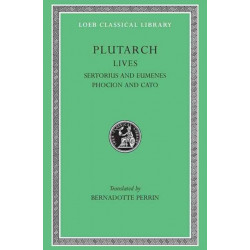
Lives, Volume VIII: Sertorius and Eumenes. Phocion and Cato (Bog, Hardback, Engelsk)
Plutarch (ca. AD 45–120) wrote on many subjects. His forty-six Parallel Lives are biographies planned to be ethical examples in pairs,... Læs mere
Levering: 6 - 9 hverdage -
Roman Antiquities, Volume IV: Books 6.49–7 (Bog, Hardback, Engelsk)
The main aim of Roman Antiquities, which began to appear in 7 BC, was to reconcile Greeks to Roman rule. Of the twenty books (from the earliest times to 264 BC) we have the first nine complete; most of 10 and 11; extracts; and an epitome of the whole.
Levering: 6 - 9 hverdage -
Natural History, Volume VIII: Books 28–32 (Bog, Hardback, Engelsk)
Pliny the Elder produced in his Natural History a vast compendium of Roman knowledge. Topics included are the mathematics and metrology of the universe; world... Læs mere
Levering: 6 - 9 hverdage