Harvard University Press Forlag
-
Jewish Antiquities, Volume VI: Books 14–15 (Bog, Hardback, Engelsk)
The major works by Josephus are History of the Jewish War, from 170 BC to his own time, and Jewish Antiquities, from creation to AD 66. Also by him are an autobiographical Life and a treatise Against Apion.
Levering: 6 - 9 hverdage -
The Life. Against Apion (Bog, Hardback, Engelsk)
The major works by Josephus are History of the Jewish War, from 170 BC to his own time, and Jewish Antiquities, from creation to AD 66. Also by him are an autobiographical Life and a treatise Against Apion.
Levering: 6 - 9 hverdage -
Thebaid, Volume I: Books 1–7 (Bog, Hardback, Engelsk)
Greek literary education and Roman political reality are evident in the poetry of Statius. His Silvae are thirty-two occasional poems. His masterpiece, the epic Thebaid,... Læs mere
Levering: 6 - 9 hverdage -
History of the Peloponnesian War, Volume III: Books 5–6 (Bog, Hardback, Engelsk)
The Peloponnesian War was really three conflicts (431–421, 415–413, and 413–404 BC) that Thucydides was still unifying into one account when he died... Læs mere
Levering: 6 - 9 hverdage -
Letters to Atticus, Volume III: Letters 166–281 (Bog, Hardback, Engelsk)
In letters to his friend Atticus, Cicero (106–43 BC) reveals himself as to no other of his correspondents except perhaps his brother, and vividly depicts a momentous period in Roman history, marked by the rise of Julius Caesar and the downfall of the Republic.
Levering: 6 - 9 hverdage -
The Jewish War, Volume III: Books 5–7 (Bog, Hardback, Engelsk)
The major works by Josephus are History of the Jewish War, from 170 BC to his own time, and Jewish Antiquities, from creation to AD 66. Also by him are an autobiographical Life and a treatise Against Apion.
Levering: 6 - 9 hverdage -
Letters to Friends, Volume II: Letters 114–280 (Bog, Hardback, Engelsk)
Cicero’s letters to friends span the period from 62 BC, when his political career was at its peak, to 43 BC, when he was put to death by the victorious Triumvirs.
Levering: 6 - 9 hverdage -
Letters to Friends, Volume III: Letters 281–435 (Bog, Hardback, Engelsk)
Cicero’s letters to friends span the period from 62 BC, when his political career was at its peak, to 43 BC, when he was put to death by the victorious Triumvirs.
Levering: 6 - 9 hverdage -
Letters to Atticus, Volume I: Letters 1–89 (Bog, Hardback, Engelsk)
In letters to his friend Atticus, Cicero (106–43 BC) reveals himself as to no other of his correspondents except perhaps his brother, and vividly depicts a momentous period in Roman history, marked by the rise of Julius Caesar and the downfall of the Republic.
Levering: 6 - 9 hverdage -
In Catilinam 1–4. Pro Murena. Pro Sulla. Pro Flacco (Bog, Hardback, Engelsk)
We know more of Marcus Tullius Cicero (106–43 BC), lawyer, orator, politician and philosopher, than of any other Roman. Besides much else, his work conveys... Læs mere
Levering: 6 - 9 hverdage -
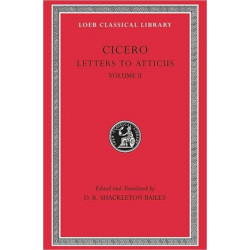
Letters to Atticus, Volume II: Letters 90–165A (Bog, Hardback, Engelsk)
In letters to his friend Atticus, Cicero (106–43 BC) reveals himself as to no other of his correspondents except perhaps his brother, and vividly depicts a momentous period in Roman history, marked by the rise of Julius Caesar and the downfall of the Republic.
Levering: 6 - 9 hverdage -
On the Latin Language, Volume I: Books 5–7 (Bog, Hardback, Engelsk)
Of more than seventy works by Varro (116–27 BC) we have only his treatise On Agriculture and part of his On the Latin Language, a work typical of its author’s... Læs mere
Levering: 6 - 9 hverdage