Harvard University Press Forlag
Visning: Type : Alle | Sprog : Engelsk | Format : Paperback / softback Der vises kun varer på engelsk
-
Walter Benjamin: Selected Writings (Bog, Paperback / softback, Engelsk)
Radical critic of a European civilization plunging into darkness, yet commemorator of the humane traditions of the old bourgeoisie--such was Walter Benjamin... Læs mere
Levering: 6 - 9 hverdage -
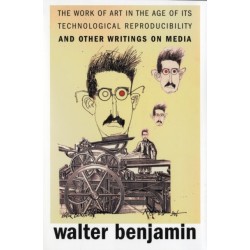
The Work of Art in the Age of Its Technological Reproducibility, and Other Writings on Media (Bog, Paperback / softback, Engelsk)
Benjamin’s famous “Work of Art“ essay sets out his boldest thoughts—on media and on culture in general. This book contains the second, and most daring, of the four versions of the “Work of Art“ essay—the one that addresses the utopian developments of the modern media.
Levering: 6 - 9 hverdage -
Value-Focused Thinking: A Path to Creative Decisionmaking (Bog, Paperback / softback, Engelsk)
Rather than placing emphasis on mechanics and fixed solutions, Keeney argues, we should focus on the bottom-line objectives that give... Læs mere
Levering: 6 - 9 hverdage -
-
Experiments in Ethics (Bog, Paperback / softback, Engelsk)
Appiah explores how new empirical moral psychology relates to the age-old project of philosophical ethics, urging that the relation between empirical research and morality, now so... Læs mere
Levering: 6 - 9 hverdage -
An Aesthetic Education in the Era of Globalization (Bog, Paperback / softback, Engelsk)
The world’s most renowned critical theorist—who defined the field of postcolonial studies—has radically reoriented her thinking. Finding the neat... Læs mere
Levering: 6 - 9 hverdage -
Strangers to Ourselves: Discovering the Adaptive Unconscious (Bog, Paperback / softback, Engelsk)
“Know thyself,” a precept as old as Socrates, is still good advice. But is introspection the best path to self-knowledge? Wilson makes the... Læs mere
Levering: 6 - 9 hverdage -
Third Thoughts: The Universe We Still Don’t Know (Bog, Paperback / softback, Engelsk)Levering: 6 - 9 hverdage
-
Why People Die by Suicide (Bog, Paperback / softback, Engelsk)
Drawing on extensive clinical and epidemiological evidence, as well as personal experience, Thomas Joiner provides the most coherent and persuasive explanation ever given of why and how people overcome life's strongest instinct, self-preservation.
Levering: 6 - 9 hverdage -
The Idea of the Muslim World: A Global Intellectual History (Bog, Paperback / softback, Engelsk)Levering: 6 - 9 hverdage
-
The Gnostics: Myth, Ritual, and Diversity in Early Christianity (Bog, Paperback / softback, Engelsk)
This book offers an illuminating discussion of recent scholarly debates over the concept of 'Gnosticism' and the nature of early Christian diversity.
Levering: 6 - 9 hverdage -
Walter Benjamin: Selected Writings (Bog, Paperback / softback, Engelsk)
This first volume shows that even as a young man Walter Benjamin possessed astonishing intellectual range and depth. His topics here include poetry and fiction, drama, philosophy, history, religion, love, violence, morality, mythology, painting, and much more.
Levering: 6 - 9 hverdage