Harvard University Press Forlag
-
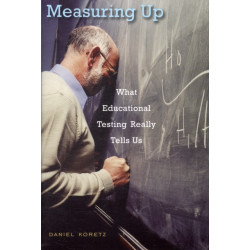
Measuring Up: What Educational Testing Really Tells Us (Bog, Paperback / softback, Engelsk)
Measuring Up demystifies educational testing—from MCAS to SAT to WAIS. Bringing statistical terms down to earth, Koretz takes readers through the... Læs mere
Levering: 6 - 9 hverdage -
A New Science: The Discovery of Religion in the Age of Reason (Bog, Hardback, Engelsk)
We see the word 'religion' everywhere, yet do we understand what it means, and is there a consistent worldwide understanding? Who discovered religion and in what context? This title offers an argument that the comparative study of religion finds its origin in early modern Europe.
Levering: Skaffevare (forvent 14 - 30 hverdage) -
The Showman and the Slave: Race, Death, and Memory in Barnum’s America (Bog, Paperback / softback, Engelsk)
Reiss uses P. T. Barnum's Joice Heth hoax to examine the race relations in the antebellum North. Barnum's first exhibit as a showman,... Læs mere
Levering: Skaffevare (forvent 14 - 30 hverdage) -
Race and Reunion: The Civil War in American Memory (Bog, Paperback / softback, Engelsk)
No historical event has left as deep an imprint on America's collective memory as the Civil War. In the war's aftermath, Americans had to embrace and... Læs mere
Levering: 6 - 9 hverdage -
On the Origin of Stories: Evolution, Cognition, and Fiction (Bog, Paperback / softback, Engelsk)
Brian Boyd explains why we tell stories and how our minds are shaped to understand them. After considering art as adaptation, Boyd examines... Læs mere
Levering: 6 - 9 hverdage -
The Image of the Black in Western Art, Volume I: From the Pharaohs to the Fall of the Roman Empire (Bog, Hardback, Engelsk)
Offers commentary and an illustrated history of the representations of people of African... Læs mere
Levering: 6 - 9 hverdage -
Letters to Friends (Bog, Hardback, Engelsk)
The letters of Bartolomeo Fonzio—a leading literary figure in Florence of the time of Lorenzo de’ Medici and Machiavelli—are a window into the world of Renaissance humanism and... Læs mere
Levering: 6 - 9 hverdage -
Moscow, the Fourth Rome: Stalinism, Cosmopolitanism, and the Evolution of Soviet Culture, 1931–1941 (Bog, Hardback, Engelsk)
The sixteenth-century monk Filofei proclaimed Moscow the Third Rome. By the 1930s, intellectuals and... Læs mere
Levering: Skaffevare (forvent 14 - 30 hverdage) -
On Dionysius the Areopagite: The Divine Names, Part II (Bog, Hardback, Engelsk)
In 1490/92 the Florentine Platonist Marsilio Ficino made new translations of two treatises he believed were the work of Dionysius the... Læs mere
Levering: 6 - 9 hverdage -
The Global Transformation of Time: 1870–1950 (Bog, Hardback, Engelsk)
As railways, steamships, and telegraph communications brought distant places into unprecedented proximity, previously minor discrepancies in local... Læs mere
Levering: 6 - 9 hverdage -
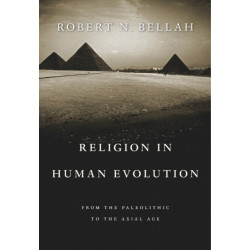
Religion in Human Evolution: From the Paleolithic to the Axial Age (Bog, Paperback / softback, Engelsk)Levering: 6 - 9 hverdage
-
Global Inequality: A New Approach for the Age of Globalization (Bog, Paperback / softback, Engelsk)
Branko Milanovic presents a bold account of the dynamics that drive inequality on a global scale. Using vast data sets, he explains the... Læs mere
Levering: 6 - 9 hverdage