Harvard University Press Forlag
-
On the Orator: Books 1–2 (Bog, Hardback, Engelsk)
We know more of Marcus Tullius Cicero (106–43 BC), lawyer, orator, politician and philosopher, than of any other Roman. Besides much else, his work conveys the turmoil of his time,... Læs mere
Levering: 6 - 9 hverdage -
History, Volume II: Books 20–26 (Bog, Hardback, Engelsk)
Ammianus, a Greek from Antioch, served many years as an officer in the Roman army, then settled in Rome, where he wrote a Latin history of the Roman Empire. The portion that... Læs mere
Levering: 6 - 9 hverdage -
Lives, Volume VIII: Sertorius and Eumenes. Phocion and Cato (Bog, Hardback, Engelsk)
Plutarch (ca. AD 45–120) wrote on many subjects. His forty-six Parallel Lives are biographies planned to be ethical examples in pairs,... Læs mere
Levering: 6 - 9 hverdage -
Roman Antiquities, Volume IV: Books 6.49–7 (Bog, Hardback, Engelsk)
The main aim of Roman Antiquities, which began to appear in 7 BC, was to reconcile Greeks to Roman rule. Of the twenty books (from the earliest times to 264 BC) we have the first nine complete; most of 10 and 11; extracts; and an epitome of the whole.
Levering: 6 - 9 hverdage -
Natural History, Volume VIII: Books 28–32 (Bog, Hardback, Engelsk)
Pliny the Elder produced in his Natural History a vast compendium of Roman knowledge. Topics included are the mathematics and metrology of the universe; world... Læs mere
Levering: 6 - 9 hverdage -
Library of History, Volume XII: Books 33–40. Index (Bog, Hardback, Engelsk)
Library of History is in three parts: mythical history to the Trojan War; history to Alexander’s death (323 BC); history to 54 BC. Books 1–5 and 11–20 survive complete, the rest in fragments.
Levering: 6 - 9 hverdage -
Library of History, Volume II: Books 2.35–4.58 (Bog, Hardback, Engelsk)
Library of History is in three parts: mythical history to the Trojan War; history to Alexander’s death (323 BC); history to 54 BC. Books 1–5 and 11–20 survive complete, the rest in fragments.
Levering: 6 - 9 hverdage -
Library of History, Volume III: Books 4.59–8 (Bog, Hardback, Engelsk)
Library of History is in three parts: mythical history to the Trojan War; history to Alexander’s death (323 BC); history to 54 BC. Books 1–5 and 11–20 survive complete, the rest in fragments.
Levering: 6 - 9 hverdage -
The The Orator’s Education, Volume III: Books 6–8 (Bog, Hardback, Engelsk)
Quintilian, born in Spain about AD 35, became a renowned and successful teacher of rhetoric in Rome. In The Orator’s Education (Institutio Oratoria), a... Læs mere
Levering: 6 - 9 hverdage -
Claudian, Volume II: On Stilicho’s Consulship 2–3. Panegyric on the Sixth Consulship of Honorius. The Gothic War. Shorter Poems. Rape of Proserpina (Bog, Hardback, Engelsk)
Claudian displays poetic as well as rhetorical skill in his diverse set of works. A panegyric on the brothers Probinus and Olybrius was followed mostly by epics in hexameters, but also by elegiacs, epistles, epigrams, and idylls.
Levering: 6 - 9 hverdage -
Julian, Volume III: Letters. Epigrams. Against the Galilaeans. Fragments (Bog, Hardback, Engelsk)
The surviving works of the Roman Emperor Julian “the Apostate” (331 or 332–363 CE) include eight Orations; Misopogon (Beard-hater),... Læs mere
Levering: 6 - 9 hverdage -
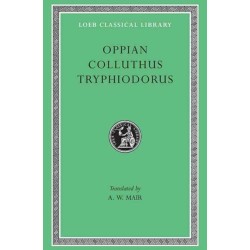
Oppian. Colluthus. Tryphiodorus (Bog, Hardback, Engelsk)
In Fishing, Oppian discusses fish and gives angling instructions. The Chase, on hunting, may be the work of a Syrian imitator. Colluthus and Tryphiodorus (properly Triphiodorus), epic poets of Egypt, wrote in the second half of the fifth century AD.
Levering: 6 - 9 hverdage