Harvard University Press Forlag
-
Oppian. Colluthus. Tryphiodorus (Bog, Hardback, Engelsk)
In Fishing, Oppian discusses fish and gives angling instructions. The Chase, on hunting, may be the work of a Syrian imitator. Colluthus and Tryphiodorus (properly Triphiodorus), epic poets of Egypt, wrote in the second half of the fifth century AD.
Levering: 6 - 9 hverdage -
Select Papyri, Volume I: Private Documents (Bog, Hardback, Engelsk)
Greek papyri relating to private and public business in Egypt from before 300 BC to the eighth century AD inform us about administration; social and economic conditions in Egypt; Egyptian, Greek, Roman, and Byzantine law. They also offer glimpses of ordinary life.
Levering: 6 - 9 hverdage -
On the Latin Language, Volume II: Books 8–10 and Fragments (Bog, Hardback, Engelsk)
Of more than seventy works by Varro (116–27 BC) we have only his treatise On Agriculture and part of his On the Latin Language, a work typical of its... Læs mere
Levering: 6 - 9 hverdage -
Roman Antiquities, Volume III: Books 5–6.48 (Bog, Hardback, Engelsk)
The main aim of Roman Antiquities, which began to appear in 7 BC, was to reconcile Greeks to Roman rule. Of the twenty books (from the earliest times to 264 BC) we have the first nine complete; most of 10 and 11; extracts; and an epitome of the whole.
Levering: 6 - 9 hverdage -
Lucian, Volume VIII: Soloecista. Lucius or The Ass. Amores. Halcyon. Demosthenes. Podagra. Ocypus. Cyniscus. Philopatris. Charidemus. Nero (Bog, Hardback, Engelsk)
Lucian (ca. AD 120–190), apprentice sculptor then traveling rhetorician, settled in Athens and... Læs mere
Levering: Skaffevare (forvent 14 - 30 hverdage) -
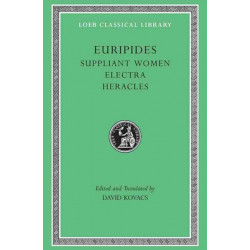
Suppliant Women. Electra. Heracles (Bog, Hardback, Engelsk)
Euripides (ca. 485–406 BC) has been prized in every age for his emotional and intellectual drama. Eighteen of his ninety or so plays survive complete, including Medea,... Læs mere
Levering: 6 - 9 hverdage -
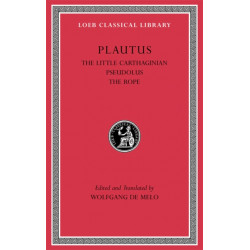
The Little Carthaginian. Pseudolus. The Rope (Bog, Hardback, Engelsk)
The comedies of Plautus, who brilliantly adapted Greek plays for Roman audiences ca. 205–184 BC, are the earliest Latin works to survive complete and... Læs mere
Levering: 6 - 9 hverdage -
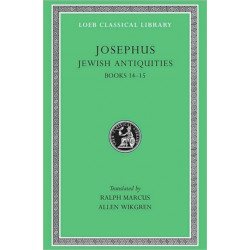
Jewish Antiquities, Volume VI: Books 14–15 (Bog, Hardback, Engelsk)
The major works by Josephus are History of the Jewish War, from 170 BC to his own time, and Jewish Antiquities, from creation to AD 66. Also by him are an autobiographical Life and a treatise Against Apion.
Levering: 6 - 9 hverdage -
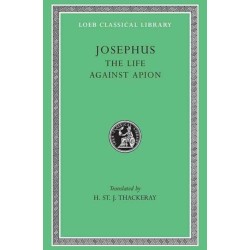
The Life. Against Apion (Bog, Hardback, Engelsk)
The major works by Josephus are History of the Jewish War, from 170 BC to his own time, and Jewish Antiquities, from creation to AD 66. Also by him are an autobiographical Life and a treatise Against Apion.
Levering: 6 - 9 hverdage -
Thebaid, Volume I: Books 1–7 (Bog, Hardback, Engelsk)
Greek literary education and Roman political reality are evident in the poetry of Statius. His Silvae are thirty-two occasional poems. His masterpiece, the epic Thebaid,... Læs mere
Levering: 6 - 9 hverdage -
History of the Peloponnesian War, Volume III: Books 5–6 (Bog, Hardback, Engelsk)
The Peloponnesian War was really three conflicts (431–421, 415–413, and 413–404 BC) that Thucydides was still unifying into one account when he died... Læs mere
Levering: 6 - 9 hverdage -
Letters to Atticus, Volume III: Letters 166–281 (Bog, Hardback, Engelsk)
In letters to his friend Atticus, Cicero (106–43 BC) reveals himself as to no other of his correspondents except perhaps his brother, and vividly depicts a momentous period in Roman history, marked by the rise of Julius Caesar and the downfall of the Republic.
Levering: 6 - 9 hverdage