Duke University Press Forlag
Visning: Type : Alle | Sprog : Alle | Format : Alle
-
Intimate Eating: Racialized Spaces and Radical Futures (Bog, Paperback / softback, Engelsk)
Anita Mannur examines how cooking, eating, and distributing food can create new forms of kinship, intimacy, and social and political belonging for people of color, queer people, and other marginalized subjects.
Levering: 6 - 9 hverdage -
Familial Undercurrents: Untold Stories of Love and Marriage in Modern Iran (Bog, Paperback / softback, Engelsk)
Afsaneh Najmabadi draws on her family history to tell a larger story of the transformations of notions of love, marriage, and family life in mid-twentieth-century Iran.
Levering: 6 - 9 hverdage -
-
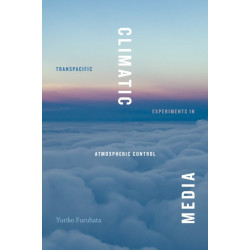
Climatic Media: Transpacific Experiments in Atmospheric Control (Bog, Paperback / softback, Engelsk)
Yuriko Furuhata traces climate engineering from the early twentieth century to the present, showing how a range of Japanese scientists, technicians, architects, and artists developed technologies to monitor, condition, and modify climate.
Levering: 6 - 9 hverdage -
Queer African Cinemas (Bog, Hardback, Engelsk)
Lindsey B. Green-Simms examines films produced by and about queer Africans in the first two decades of the twenty-first century, showing how these films record the fear, anxiety,... Læs mere
Levering: 6 - 9 hverdage -
Legal Spectatorship: Slavery and the Visual Culture of Domestic Violence (Bog, Paperback / softback, Engelsk)
Kelli Moore traces the political origins of the concept of domestic violence through visual culture in the United States, showing how it is rooted in the archive of slavery.
Levering: 6 - 9 hverdage -
Settler Garrison: Debt Imperialism, Militarism, and Transpacific Imaginaries (Bog, Paperback / softback, Engelsk)
Jodi Kim examines how the United States extends its sovereignty across Asia and the Pacific in the post-World War II era through a militarist settler imperialism that is leveraged on debt.
Levering: 6 - 9 hverdage -
Passionate Work: Endurance After the Good Life (Bog, Paperback / softback, Engelsk)
Renyi Hong theorizes the notion of being “passionate about your work” as an affective project that encourages people to endure economically trying situations like unemployment, job change, repetitive and menial labor, and freelancing.
Levering: 6 - 9 hverdage -
The Impasse of the Latin American Left (Bog, Paperback / softback, Engelsk)
Franck Gaudichaud, Massimo Modonesi, and Jeffery R. Webber explore the Latin American Pink Tide as a political, economic, and cultural phenomenon, showing how it... Læs mere
Levering: 6 - 9 hverdage -
Subversive Habits: Black Catholic Nuns in the Long African American Freedom Struggle (Bog, Paperback / softback, Engelsk)
Shannen Dee Williams provides a comprehensive history of Black Catholic nuns in the United States, tracing how Black sisters’ struggles were central to the long African American freedom movement.
Levering: 6 - 9 hverdage -
The Lives of Jessie Sampter: Queer, Disabled, Zionist (Bog, Paperback / softback, Engelsk)
Sarah Imhoff tells the story of the queer, disabled, Zionist writer Jessie Sampter (1883–1938), whose body and life did not match typical Zionist ideals and serves as an example of the complex relationships between the body, queerness, disability, religion, and nationalism.
Levering: 6 - 9 hverdage -
Queer Companions: Religion, Public Intimacy, and Saintly Affects in Pakistan (Bog, Paperback / softback, Engelsk)
Omar Kasmani theorizes the construction of queer social relations at Pakistan’s most important Sufi site by examining the affective and intimate relationship between the site’s pilgrims and its patron saint.
Levering: 6 - 9 hverdage